

Most roofer marketing advice is a channel catalog: forty tactics, no prices, no evidence, no order. This guide is built the other way around, from three facts that should shape every roofing company’s plan, each linked to its source, followed by the channels ranked against them, the budget math, and the build order.
The three facts that shape everything
Fact 1: Homeowners find roofers through people and search. Roofing Contractor’s 2026 homeowner survey: 74% find roofing contractors through word of mouth, 54% through search engines, with lead platforms far behind at roughly a third in the prior edition. Your marketing plan should look like those numbers.
Fact 2: Reviews gate everything. BrightLocal’s 2026 survey: 97% of consumers read reviews, 31% require 4.5+ stars, 47% skip businesses with fewer than 20 reviews, 74% discount reviews older than three months. Even the referred homeowner audits you before calling.
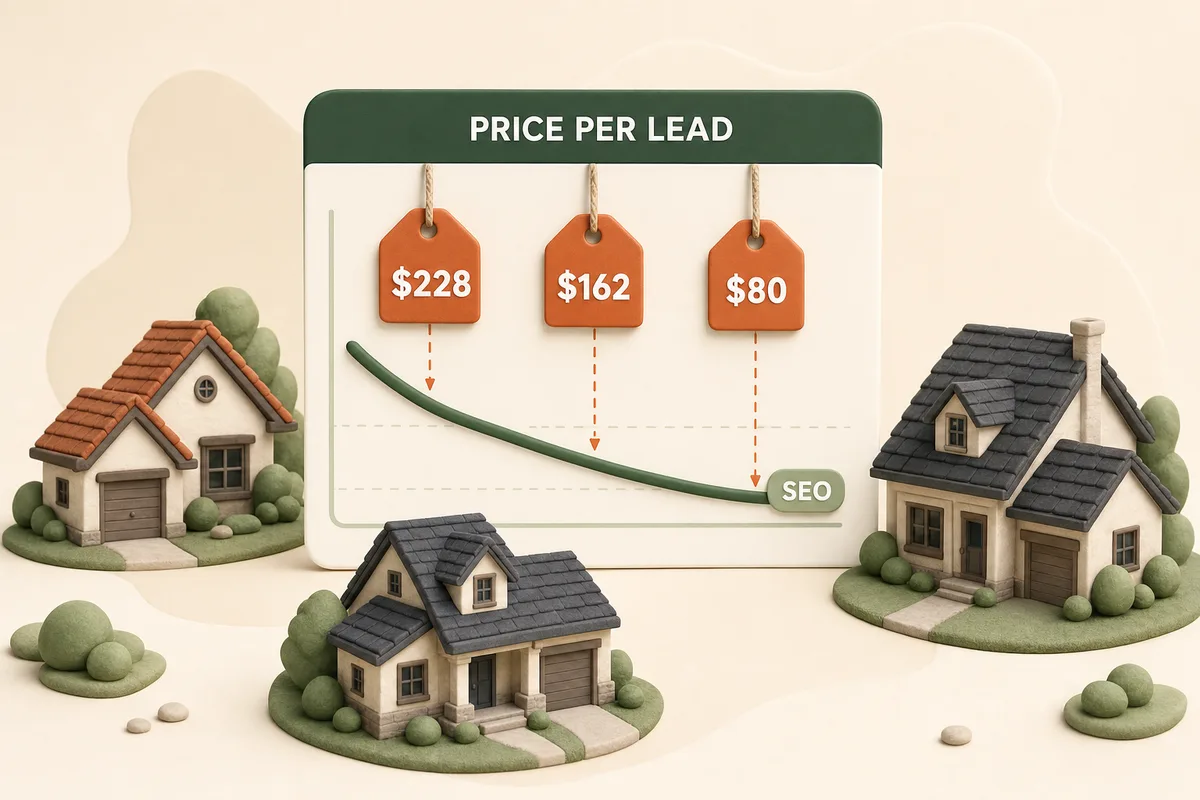
Fact 3: Roofing attention is the most expensive in home services. LocaliQ’s benchmark data: roofing search ads run $10.70 a click and $228.15 a lead, 3.4 times the all-industry average. Whatever channel mix you pick, roofing pays top dollar to rent attention, which is the standing argument for owning it instead.
The sorting principle: owned versus rented
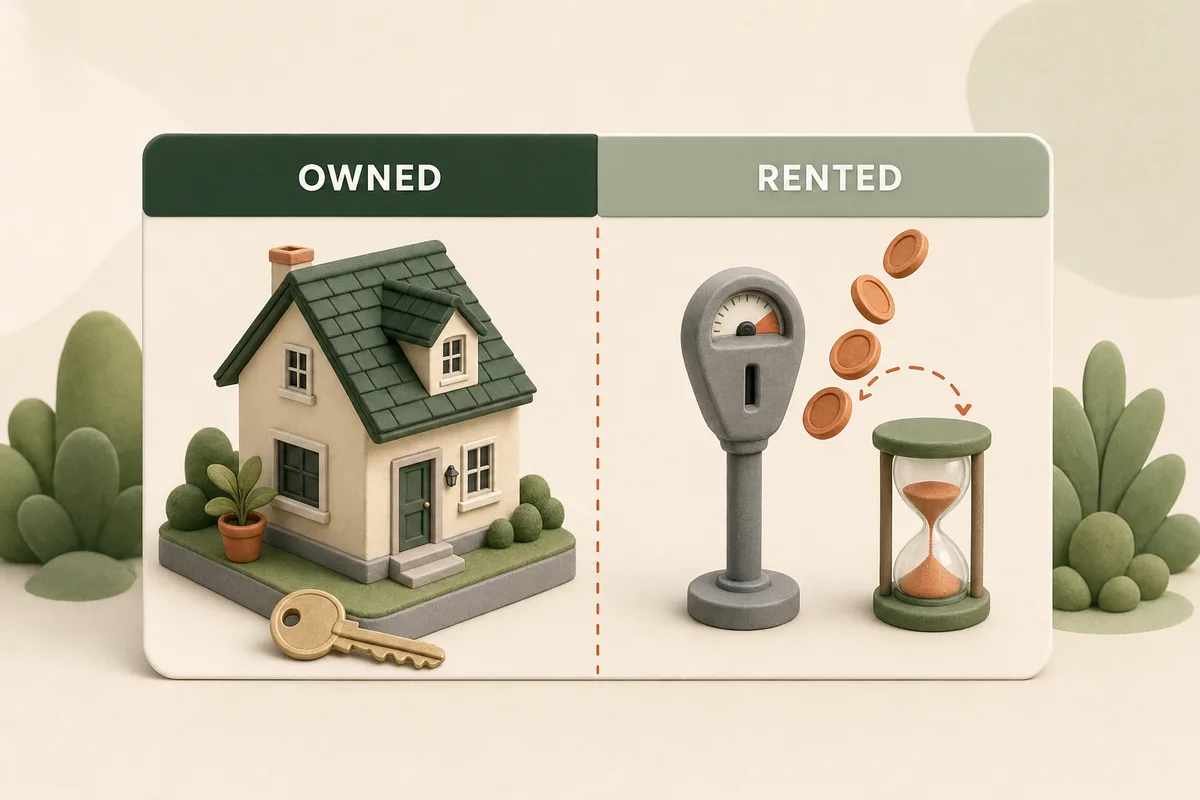
Every channel in roofing marketing is one or the other.
Owned channels are assets: your website and rankings, your Business Profile, your review profile, your referral network, your content. They take months to build and then compound, producing leads at falling marginal cost, and they remain yours through any agency change.
Rented channels are meters: Google Ads, Local Services Ads, marketplaces, direct mail. They start instantly, cost the same or more every month forever, and stop the day you stop paying.
Neither is evil. The strategic error, and the most common one in roofing, is renting everything forever while the owned assets sit unbuilt. The five-year math between the two is the difference between an expense history and a balance sheet.
The owned stack, in build order
1. Google Business Profile. The storefront for the 54% who search and the verification stop for the 74% who were referred. Google’s own research says complete profiles make customers 2.7x more likely to consider a business reputable. Setup rules and cadences: the GBP guide.
2. The review engine. The per-job ask with the direct link, responses to everything, and a strict line around the practices that now carry FTC penalties up to $53,088 per violation. This is the highest-return habit in roofing marketing and it costs nothing.
3. The website, structured to rank and convert. One page per service, one per major city, built on real keyword data: “roof repair near me” alone carries 67,000 US monthly searches. What a proper build costs, honestly: the website cost guide. And put pricing on it: 65% of homeowners are more likely to call a contractor with transparent pricing, and almost nobody does it.
4. SEO as an ongoing system. Content, local signals, technical upkeep, and links compounding month over month: the complete system, what it costs, and the honest month-by-month timeline. If your work skews metal or commercial, those clusters are open and premium.
5. The referral system. Word of mouth, engineered: the close-out ask, the thank-you without rewards, and the adjacent-trade network of realtors, adjusters, and inspectors, detailed here.
6. Storm readiness. In storm markets, the pages, profile posts, and process built before the season, per the playbook. NOAA logs tens of thousands of severe weather reports a year; the roofers who win those weeks prepared in the quiet ones.
7. AI-search readiness. 45% of consumers now use AI tools for local recommendations, and assistants cite the same evidence layer the rest of this stack builds. Mostly free, mostly the same fundamentals, one new door to leave open.
The rented channels, with price tags
Used deliberately, rented speed has a place. The benchmark prices to negotiate against:
- Google Local Services Ads: pay per lead, Google-screened, roughly $162 per roofing lead in the only published trade dataset, over 90% arriving by phone. The best-behaved paid channel for most roofers.
- Google Ads: $228 per lead at benchmarks, exclusive and instant. Right for gaps, new territories, and storm overflow; wrong as a foundation. The full comparison.
- Marketplaces (Angi, HomeAdvisor, Thumbtack): $50 to $120+ per shared lead, up to five competitors per lead by Angi’s own documentation, and real acquisition costs that routinely pass $1,000 per booked job. Bridge material only.
- Traditional (direct mail, radio, billboards): unmeasurable by design in most deployments. If you run them, run them as brand support for the owned stack, not as lead generators, and track everything you can.
The budget, from the survey data
Gartner’s 2026 CMO survey puts average marketing budgets at 7.8% of revenue; The CMO Survey reads 9.0%, and its size breakouts show companies under $10M reporting 13.3%. The working framework from our budget guide: 4 to 5% of revenue to maintain, 7 to 10% to grow, 10%+ to push aggressively. A $2M roofer in growth mode is budgeting roughly $12,000 to $17,000 a month across everything, trucks and yard signs included.
Then hold every channel to one metric: spend divided by jobs booked, monthly, per channel. That single habit exposes every marketing mistake in this industry within a quarter, and it is the math the lead-cost scorecard runs across all channels.
Choosing help, if you outsource
The industry you would be hiring from has, by its own customers’ scoring, a Net Promoter Score of zero. Protection is procedural: the 10 questions covering ownership, terms, exclusivity, and tracking, plus what fair pricing looks like and who the honest alternatives are, competitors included. Any provider who flinches at the questions has answered them.
Our own answers, on the record: one flat plan, $3,500 a month, everything included, month to month, you own all of it, one roofing company per service area.
The 12-month build order
- This week: Business Profile to spec, review asks live on every job, listings cleaned.
- Month 1-2: Website structured to rank and convert, transparent pricing published, tracking wired.
- Month 2-3: Referral system running; paid channel on only if the calendar needs bridging.
- Month 3-6: SEO engine shipping content; storm pages built before season; first organic leads arriving.
- Month 6-12: Compounding: rankings hardening, cost per booked job falling, paid spend tapering to surgical use.
- Every month, forever: spend divided by booked jobs, per channel, on one sheet of paper.
That is the whole guide. The channels homeowners use, the prices the data supports, the assets that compound, and the order that builds them. If you want it mapped to your specific company and market, get a free audit: I will score your owned stack, price your rented spend honestly, and hand you the build order for your next twelve months.
Frequently asked questions
- What is the best marketing for roofers?
- The channels homeowners actually use to find roofers: word of mouth (74% in Roofing Contractor's 2026 homeowner survey) and online search (54%). In practice: a systematic referral and review engine, a complete Google Business Profile, and a website that ranks for your services and cities, supplemented by paid channels when speed matters. Everything else is support for those.
- How much should roofers spend on marketing?
- Survey benchmarks put average marketing budgets at 7.8% of revenue (Gartner, 2026) to 9.0% (The CMO Survey, 2026), with companies under $10M reporting 13.3%. A working framework: 4 to 5% of revenue to maintain, 7 to 10% to grow, 10%+ for aggressive pushes. For a $2M roofer in growth mode, that is roughly $12,000 to $17,000 a month across all channels.
- How do roofers get customers without buying leads?
- Through the two channels the homeowner data ranks first: engineered word of mouth (the referral ask after every job, adjacent-trade relationships, visible jobsite excellence) and owned search presence (Business Profile, reviews past homeowner thresholds, a site with one page per service and city). Both compound; bought leads reset every month.
- Is digital marketing worth it for roofing companies?
- The homeowner behavior makes it unavoidable: 54% search online for roofers, 97% read reviews, and even referred customers check you online before calling. The real question is rent versus own: paying $228 per ad lead forever, or building rankings and reviews that produce leads at falling cost. For established roofers, owning wins the five-year math decisively.
Read more

Roofing marketing ideas that actually work (and the ones to skip)
Fifteen roofing marketing ideas ranked by evidence: what the homeowner data supports, what the cost data kills, and where to start with a real budget.
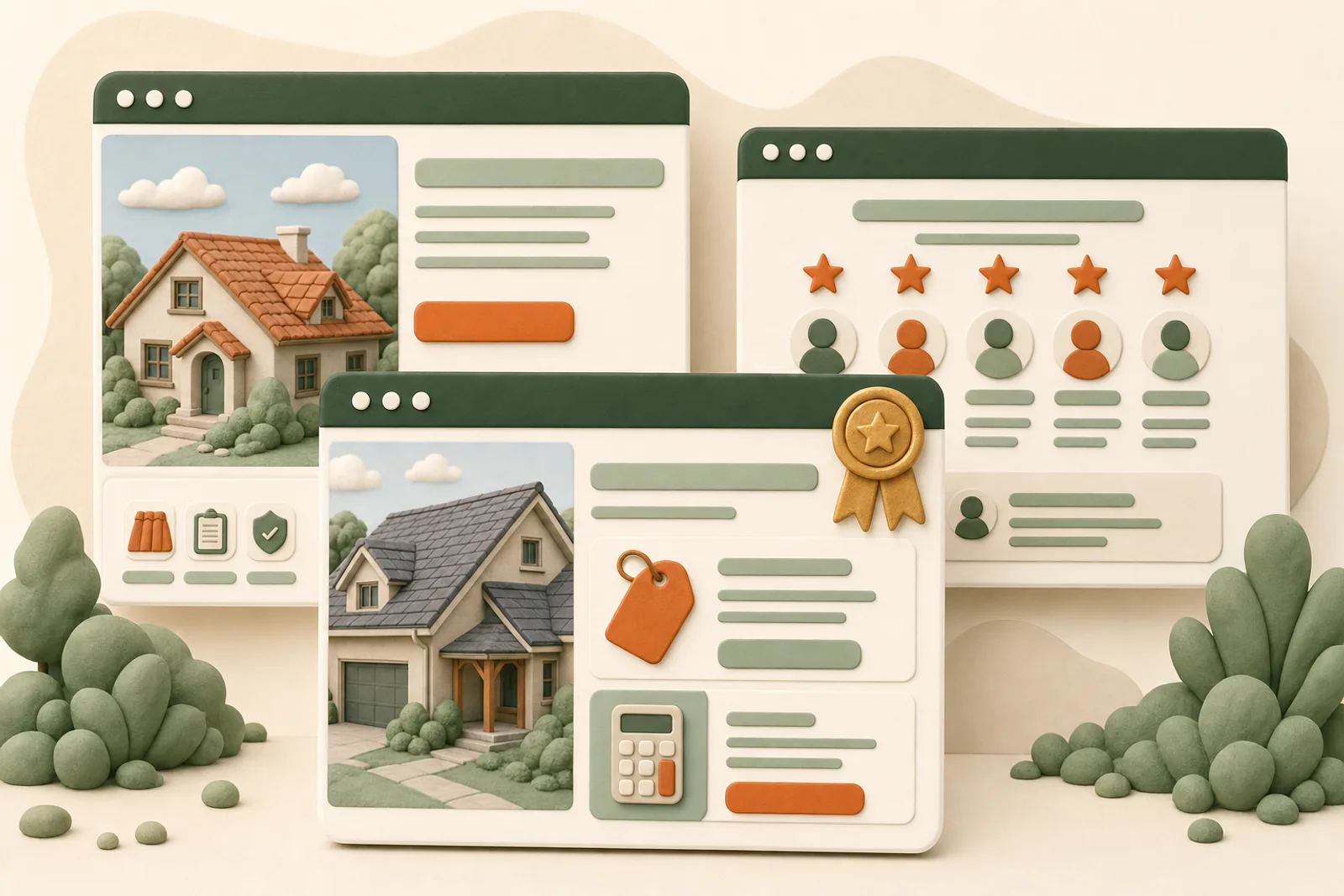
The best roofing websites: what 11 real sites do differently
We inspected 11 real roofing company websites and recorded what the strong ones actually do: the trust math, the CTAs, the pricing tools, and the gaps even good sites leave.