


Every “best roofing websites” roundup on the internet is written by someone selling roofing websites, this one included, so we did the one thing the others skip: we actually inspected the sites, and every observation below is something we recorded on the named site itself. No placements, no clients, no screenshots from 2019.
Eleven sites, the specific things each does well, the patterns they share, and the gap almost all of them leave open.
The standouts, and exactly why
Victors Home Solutions (Midwest) is the best review display we found anywhere: instead of a vague “5-star rated,” the homepage shows per-platform counts and ratings: 4,655 Google reviews at 4.8, BBB A+ at 4.69, Guild Quality at 5.0. That is the review thresholds homeowners apply answered before the question is asked, plus a 50-year leak-free guarantee and financing stated outright.
Bumble Roofing (multi-state) leads with “Get Your Instant Quote” and the tagline “No Haggling, No Gimmicks, No Pressure Ever.” An instant-quote tool is the strongest possible implementation of the transparent-pricing preference 65% of homeowners report, and almost nobody in the industry offers one.
Mr. Roof stacks quantified trust like a proof wall: 500,000+ installs, 1,500+ five-star reviews, A+ BBB, 60+ years, financing in the headline (“0% Interest for 6 Years”), and a memorable promise: “Done in a day. Good for a lifetime.” Numbers beat adjectives, and this site is the demonstration.
Cloud Roofing (San Antonio) is the local-structure example: “Trusted San Antonio Roofing Company” as the headline, warranty terms stated plainly (10-year on replacements), job counts (2,500+), and the since-1975 line. This is the one-page-per-intent architecture worn openly.
White Castle Roofing (Nebraska) shows how multi-location should look: six location pages, a 4.9 Google rating up front, and a memorable community stat ($1M+ in free roofs). Cedar Roofing (Illinois) does scale proof with an address and license visible: 80,000 projects, 85 team members, street address in the header area. Chet’s Roofing (Seattle) runs real before-and-after project proof with named testimonials and named financing (Wells Fargo). Guardian Roofing (Pacific Northwest) adds booking convenience: header phone plus a Book Online button, a productized “17-point digital roof analysis,” and 24/7 emergency response stated.
Also inspected and worth a look: Able Roofing (Columbus) for local address plus big trust numbers, Janney Roofing (Florida) for values-led messaging with award badges, and Timberline Roofing (Vancouver Island) as the only site we found with a dedicated roof cost calculator in the main navigation.
The patterns the strong sites share
Across the eleven, observed with our own fetches:
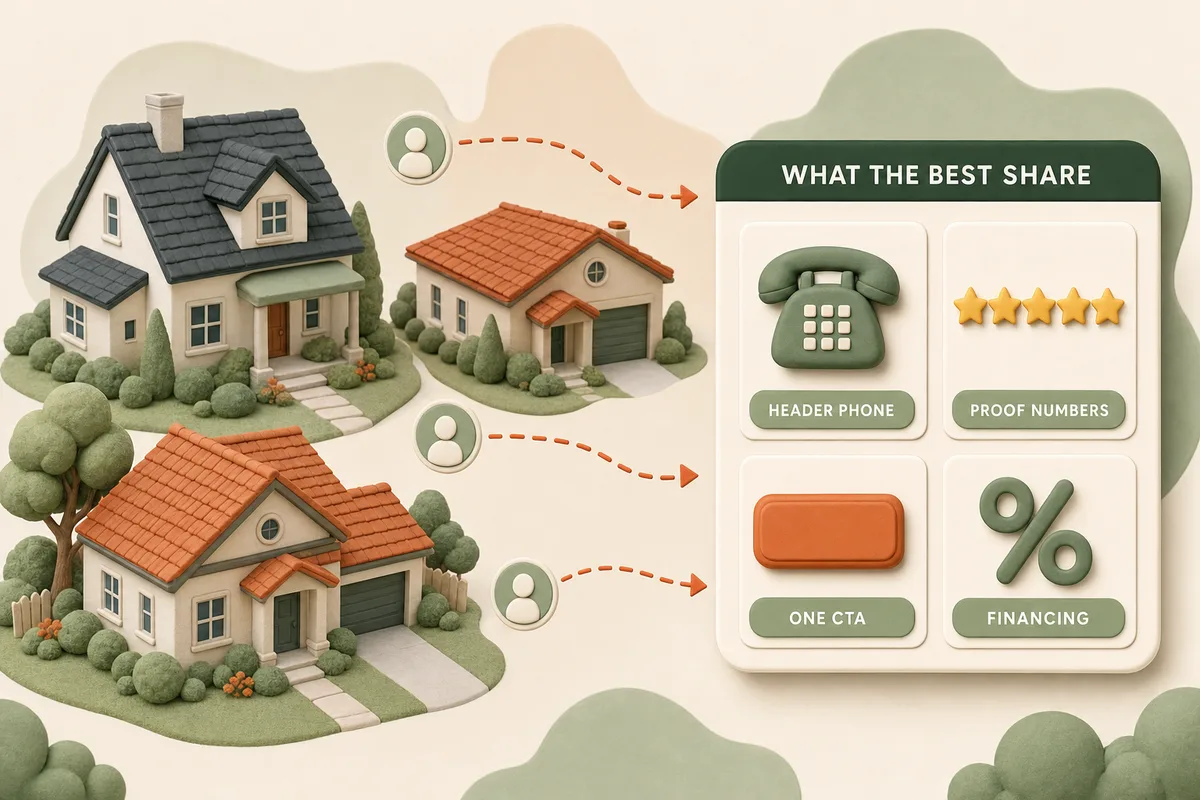
- Phone number in the header on ten of eleven. The single most consistent feature of good roofing sites, and still missing from thousands of others.
- Quantified trust near the top. Years in business on nine sites (since 1975, 1982, 1985, 1998…), install counts, review counts. Specific numbers, not “trusted and reliable.”
- One primary action, usually free. “Free estimate,” “free inspection,” or “instant quote,” repeated consistently rather than competing CTAs.
- Financing addressed openly. “0% interest,” named lenders, dedicated financing pages. For a five-figure purchase, hiding financing costs deals.
- Real proof over stock. Project galleries, before/afters, named testimonials with dates.
None of this is expensive. All of it is deliberate, which is the actual difference between these sites and the average roofing site: someone decided what the homepage’s job was.
The gap even the good sites leave
Here is the opportunity the inspection surfaced: only two of eleven strong sites offer any pricing transparency (Bumble’s instant quote and Timberline’s calculator), while 65% of homeowners say they are more likely to call a contractor with transparent pricing. The best sites in the industry are leaving the most-preferred trust feature on the table, which means a roofer who adds honest ranges or a calculator differentiates against even the strongest competitors in this list. That, plus tracking (invisible from outside, absent by default), is where our own builds start.
The build list, extracted
Turn the observations into your checklist:
- Phone in the header, tap-to-call on mobile
- Three quantified trust numbers above the fold (years, reviews, jobs)
- One primary CTA, free, repeated everywhere
- Financing stated, not hidden
- Per-platform review display, Victors-style
- Real project proof with locations and dates
- One page per service, one per city
- Pricing transparency: ranges, examples, or a calculator
- Tracking on every number and form, so you know what works
What that build costs, honestly, from DIY to managed: the website cost guide. And if you want your current site scored against this exact list, plus the three competitors beating you locally, get a free audit. The scorecard is yours either way.
Frequently asked questions
- What makes a good roofing company website?
- The patterns from the strong sites we inspected: a phone number visible in the header, quantified trust near the top (years in business, review counts, install counts), one clear primary action (free estimate or inspection), financing addressed openly, real project proof, and pages structured by service and location. Design polish sits on top of those; it never replaces them.
- Which roofing websites are the best examples?
- From the eleven we inspected: Victors Home Solutions for review display (per-platform counts and ratings shown), Bumble Roofing for instant quoting, Cloud Roofing for local structure, Mr. Roof for quantified trust stacking, White Castle Roofing for multi-location architecture, and Timberline Roofing for a self-serve cost calculator. Each is cited for a specific observable strength, not overall endorsement.
- Should a roofing website show pricing?
- The homeowner data says yes: 65% are more likely to call a contractor with transparent pricing on the site, yet only two of the eleven strong sites we inspected offer any (an instant quote tool and a cost calculator). Ranges and calculators work without quoting exact jobs, and the rarity is exactly why it differentiates.
- How much does a roofing website like these cost?
- A professional build runs $5,000 to $10,000 upfront plus ongoing maintenance, or arrives bundled in a monthly marketing plan. The features that matter (header phone, trust numbers, service and city pages, tracking) are structural decisions more than budget ones, which is why some expensive sites still fail at them.
Read more
Roofer marketing: the complete guide for 2026
Every roofing marketing channel with its real benchmark cost, the homeowner data that ranks them, a budget framework, and the order to build. All sourced.

Roofing marketing ideas that actually work (and the ones to skip)
Fifteen roofing marketing ideas ranked by evidence: what the homeowner data supports, what the cost data kills, and where to start with a real budget.