
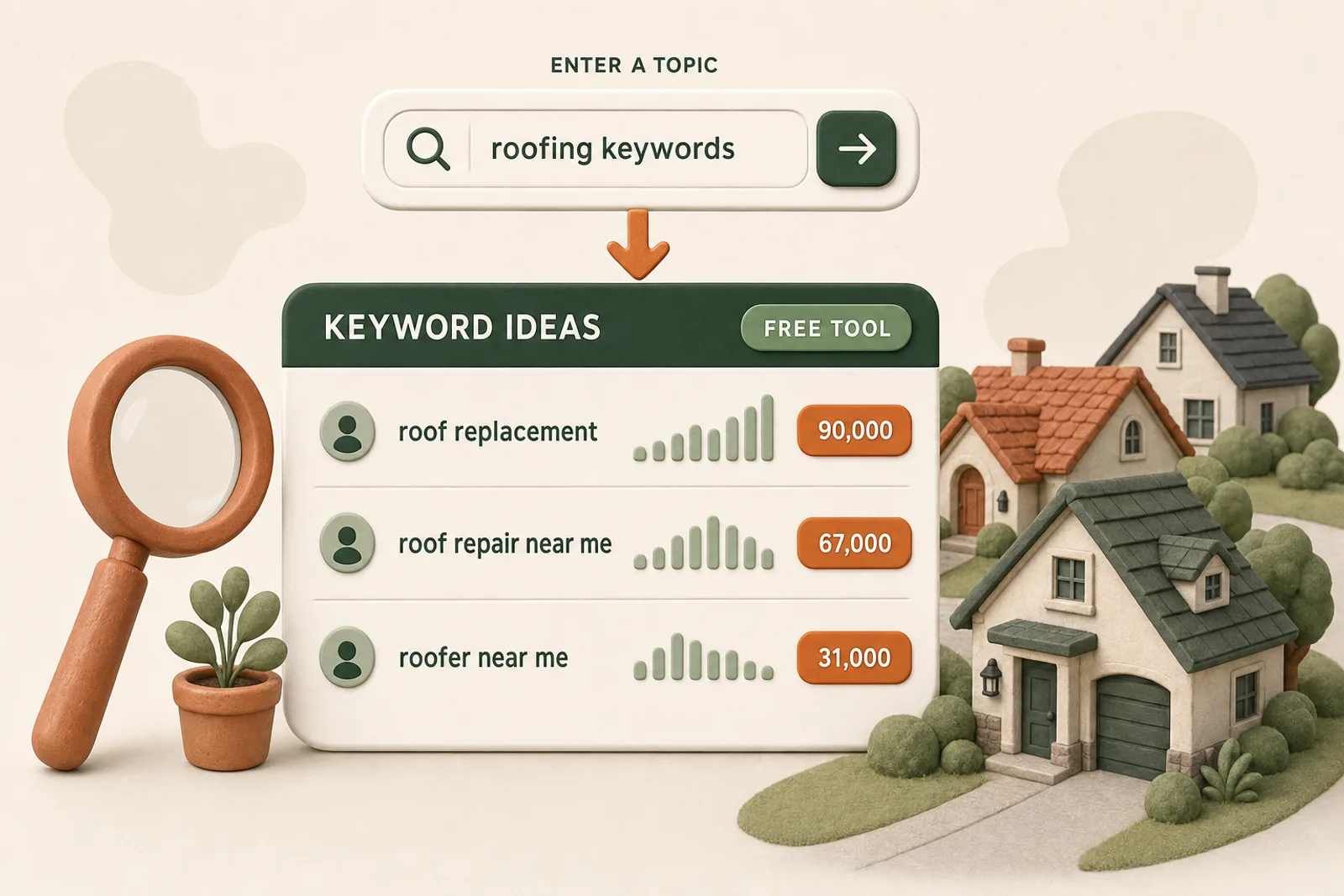

Most roofing keyword advice is a list of 100 terms someone exported from a tool and never looked at. A list does not tell you which keywords deserve a page on your site, which ones bring jobs worth taking, or how a homeowner’s search changes when water is actively dripping into their kitchen.
That is what this guide covers. The numbers below come from our free roofing keywords tool, which tracks 245 roofing terms with US search volume and ranking difficulty data.
The three kinds of roofing searches
Every roofing keyword falls into one of three buckets, and the bucket matters more than the volume.
Emergency searches. “Roof leak repair.” “Emergency roof repair near me.” The homeowner has a problem right now. These searches convert fast, close fast, and the job values are smaller, though a repair visit regularly turns into a replacement sale once you are on the roof.
Planned purchase searches. “Roof replacement.” “Roof replacement cost.” “Best roofing company [city].” This is a researched, five-figure decision. The homeowner compares contractors, reads reviews, and takes weeks. These keywords carry the money.
Research searches. “How long does a roof last.” “Signs of hail damage.” No immediate job attached, but the homeowner asking is often 6 to 18 months from becoming a buyer, and the contractor who answered their questions has the inside track.
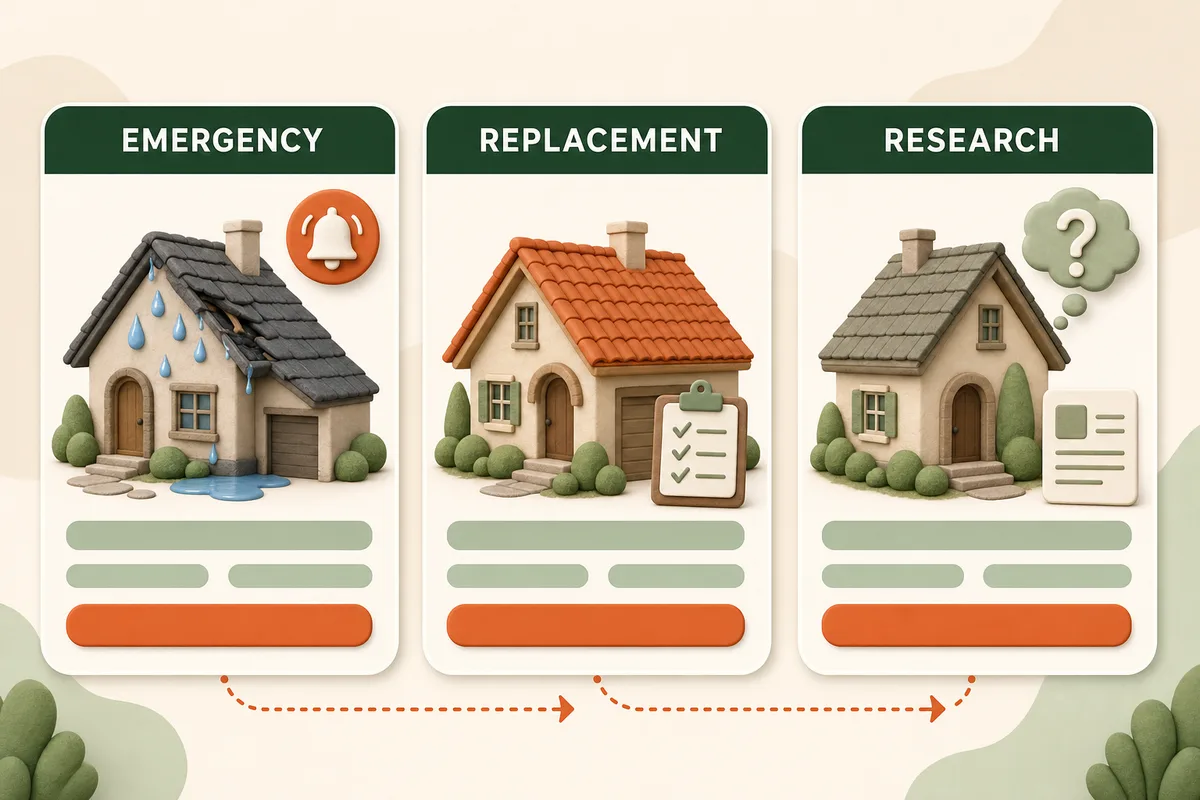
Your website needs pages for the first two buckets before you write a word for the third.
What the volume data actually shows
Here are the biggest head terms in our dataset, US monthly search volume:
- Roof replacement: 90,000 searches a month. Ranking difficulty is surprisingly low for the volume.
- Roof repair: 89,000. Even easier to rank for.
- Roof repair near me: 67,000. The single biggest “near me” term in roofing.
- Roofing contractor: 48,000. Harder: this one attracts national directories.
- Roofing company near me: 38,000.
- Roofer near me: 31,000.
- Roof leak repair: 23,000. Nearly uncontested in many markets.
Two lessons hide in that list.
First, local intent dominates roofing. Three of the seven biggest terms include “near me,” and Google localizes even the ones that do not. When someone in your city searches “roof replacement,” Google shows them roofers in your city. You are never competing with every roofer in America. You are competing with the ten in your service area.
Second, repair and replacement are different markets. Repair terms have huge volume and low difficulty. Replacement terms have high job values. A site that only targets one of them is leaving half the market to competitors. The short version: build separate pages for each.
How many keywords should you actually target?
Fewer than the lists suggest. For a single-location roofing company, 20 to 40 keywords mapped to 10 to 15 pages covers the market:
- Home page: your brand plus “roofing company [city]”
- One page per service: replacement, repair, storm damage, commercial, metal, whatever you actually sell
- One page per major city or suburb you serve
- A handful of research posts once the service pages exist
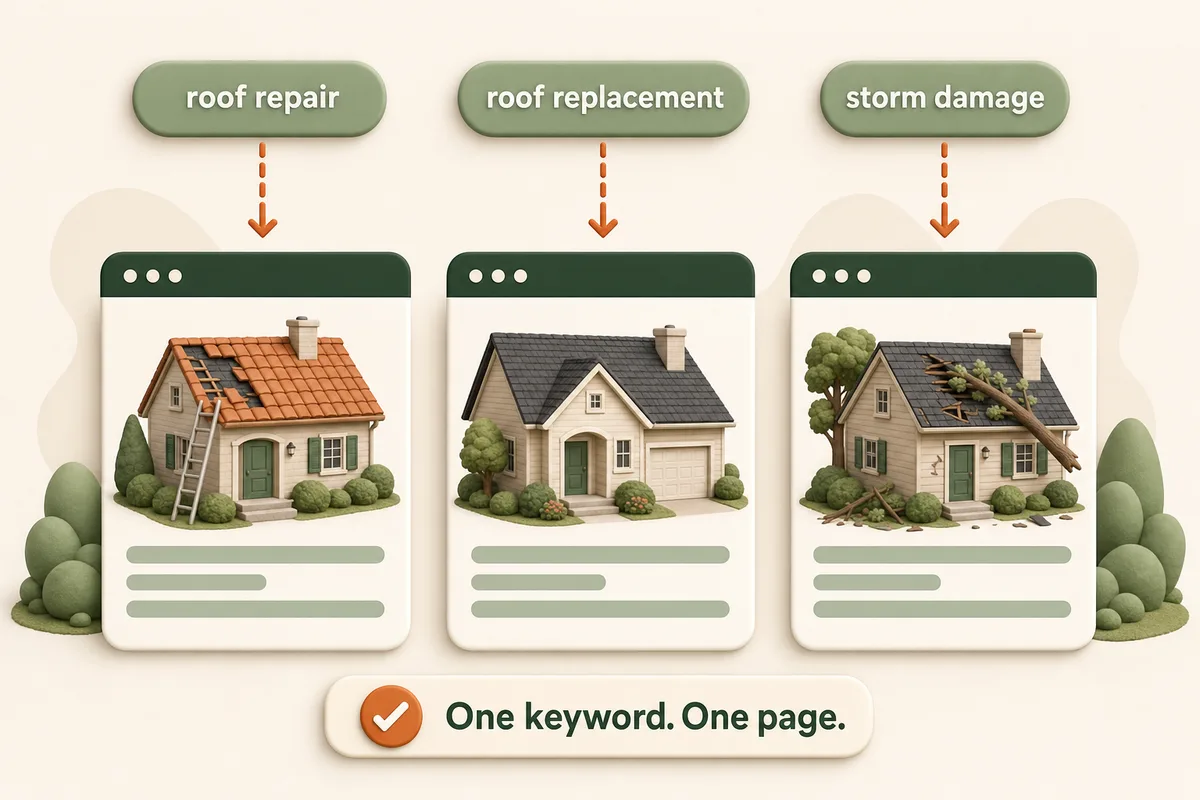
Each page targets one primary keyword and naturally picks up its variations. “Roof replacement [city]” also catches “replace roof [city],” “roof replacement cost [city],” and dozens of long-tail versions you never explicitly targeted.
The mistake we see most is the opposite approach: a 6-page website trying to rank for 300 exported keywords. Google ranks pages, not spreadsheets. No page, no ranking.
The five-step process for picking yours
Step 1: Start from your jobs, not from a tool. List the work you actually want more of, ranked by profit. If commercial flat roofs pay your best margins, “commercial roofing contractor [city]” outranks any residential term on your priority list regardless of volume. Volume tells you how many people search. Only you know which jobs you want.
Step 2: Match each service to its head terms. Use Google Keyword Planner or our free tool to find the main terms for each service. You are looking for the phrasing homeowners use, which is not always yours. Nobody searches “roofing system installation.” They search “new roof” and “roof replacement.”
Step 3: Add the local layer. For each head term, the real target is the local version: the term plus your city, plus the “near me” variant. Your Google Business Profile competes for the map results on these searches while your website competes for the organic results. Google’s own guidance confirms relevance, distance, and prominence drive those local rankings.
Step 4: Check who currently ranks. Search each candidate keyword from your service area. If the results are all national directories like Angi and Yelp, page one is hard but the map pack is winnable. If the results are local roofers with mediocre pages, both are winnable. Five minutes of searching beats any difficulty score.
Step 5: Map every keyword to a page. One primary keyword per page. If two keywords mean the same thing (“roof replacement” and “new roof”), they share a page. If they mean different things (“roof repair” and “roof replacement”), they get separate pages. This map becomes your site structure, which is why we do keyword research before we design a roofing website, not after.
Mistakes that waste your money
Chasing national volume. You cannot service a homeowner three states away. National volume numbers are only useful as a proxy for local demand.
Ignoring the searches you already get. Google Search Console is free and shows the exact queries your site already appears for. Keywords where you sit on page two are your cheapest wins. This data is the first thing we check in every SEO engagement.
Stuffing every page with every keyword. A page targeting everything ranks for nothing, and homeowners can smell a page written for Google. Write for the homeowner, target one topic, and the variations follow.
Set-and-forget. Search behavior shifts with seasons and storms. Repair terms spike after weather events. Review your keyword targets quarterly, not once at launch.
Where to go from here
Pick your 20 to 40 keywords with the process above, check them against our free roofing keywords tool, and make sure every one of them has a page to live on.
Or skip the homework: get a free audit and I will pull the keyword data for your specific market, show you what your competitors rank for that you do not, and tell you straight which keywords are worth your effort.
Frequently asked questions
- What are the best keywords for a roofing company?
- The best keywords match the jobs you actually want, in the area you serve. For most residential roofers that means local service terms like roof replacement [city], roof repair near me, and roofing company [city], plus emergency terms like roof leak repair if you handle urgent work. High volume means nothing if the keyword brings the wrong jobs.
- How many keywords should a roofing website target?
- For a single-location roofer, 20 to 40 keywords mapped across 10 to 15 pages is plenty. Each service page targets one primary keyword and a handful of close variations. Chasing hundreds of keywords spreads a small site too thin to rank for any of them.
- Do I need different keywords for repair and replacement work?
- Yes. Repair searches are urgent and high-volume with lower job values. Replacement searches are researched purchases with much higher job values. They deserve separate pages targeting separate keywords, because the homeowner is in a completely different frame of mind for each.
- What free tools can I use for roofing keyword research?
- Google Keyword Planner shows volumes if you have a Google Ads account. Google Search Console shows the queries your site already appears for. Google Business Profile insights show how customers find your listing. And our free roofing keywords tool lists 245 roofing terms with volume and difficulty data, no signup required.
Read more

Why your roofing website isn't getting leads (a 15-minute diagnosis)
The seven failure points that silence a roofing website, in the order to check them, with the homeowner behavior data that explains each one.
What to expect from roofing SEO, month by month
The honest timeline nobody puts in the proposal: what actually happens in months 1 through 12 of a roofing SEO engagement, what to measure, and when to worry.