
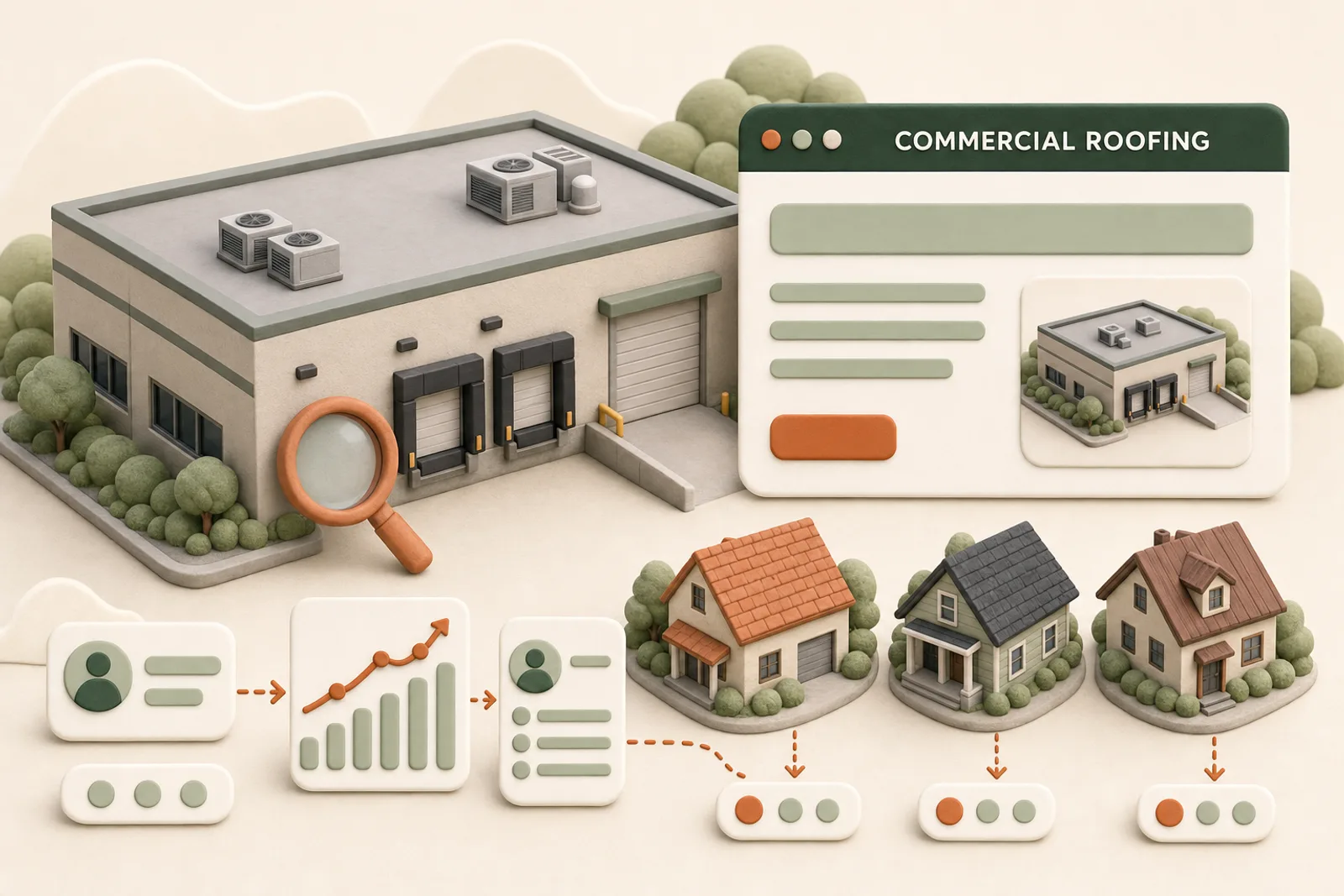

Most roofing SEO advice quietly assumes a homeowner on the other end of the search: emergency leaks, insurance claims, “roofer near me” at 9 p.m. Commercial roofing plays a different game with different buyers, different keywords, and different money, and treating it as residential-with-bigger-invoices is why most roofers’ commercial pages produce nothing.
Here is what actually changes, with the market data and buyer research to back it.
Why commercial deserves its own strategy
Two market facts set the stage. Mordor Intelligence’s US roofing analysis values the market at $32.66 billion in 2025, heading to $46.67 billion by 2031, and identifies commercial as the fastest-growing application segment at an 8.05% annual rate through 2031, driven by data centers, e-commerce warehouses, and healthcare facilities running on low-slope membrane systems. The Freedonia Group’s commercial roofing study sizes US commercial demand at 83.2 million squares in 2024, with dollar growth (3% annually) outpacing area growth as materials and systems get more valuable per square.
Stack that against job economics: a single commercial project runs $25,000 to well past six figures, and a maintenance contract keeps paying for years. A commercial client relationship is not a job. It is a revenue line.
The buyer is a researcher, not an emergency caller
The residential searcher has a leak and a phone. The commercial searcher is a property manager, facility director, or building owner working a budget cycle, and the research on how these people buy should reshape your whole site.
Gartner’s B2B buying research finds 75% of B2B buyers prefer a rep-free buying experience, and describes buyers looping through six jobs (problem identification, solution exploration, requirements building, supplier selection, validation, consensus building) rather than descending a tidy funnel. Gartner has also projected that 80% of B2B sales interactions occur in digital channels, and one more finding does the heavy lifting for content strategy: buyers who engage with supplier-provided digital tools alongside a rep are 1.8 times more likely to complete a high-quality deal.
Translate that to roofing: the facility manager comparing TPO versus EPDM at their desk, assembling budget justification for an owner, wants documentation, not a pitch. The commercial roofer whose website supplies that research is inside the buying process months before competitors know it started.

The keywords: high value, barely contested
Here is the part that should get your attention. In our 245-keyword dataset, the commercial cluster is the most underpriced real estate in roofing search:
- Commercial roofing services: 15,000 monthly US searches, difficulty 2
- Commercial roof repair: 10,000, difficulty 2
- Commercial roof replacement: 9,700, difficulty 0
- Commercial roofing contractor: 8,400, difficulty 9
- Commercial roof inspection: 6,600, difficulty 0
- Commercial roofer: 5,600, difficulty 2
That is 55,000+ combined monthly searches at difficulties in the single digits, while residential provider terms like “roofing contractor” (difficulty 60) and “roofer near me” (43) are the most contested in the industry. Add the system and material terms that skew commercial: “flat roof repair” (11,000, difficulty 0), “flat roof replacement” (5,100, difficulty 0), plus the TPO, EPDM, and metal system searches from the material cluster.
Why so open? Because most commercial roofers still run on relationships and bid lists, and most roofing SEO effort chases residential. The method for turning that gap into pages is the same one in our keywords guide; the cluster you point it at is different.
The content: proof, specs, and programs
Residential trust signals (reviews, before-and-after photos, financing) matter but do not carry a commercial deal. The content that moves property managers, built to feed the Gartner-style rep-free research loop:
- Case studies with numbers. Building type, square footage, system installed, timeline, and the problem solved. This is the single highest-value commercial content type, and the exact thing the buyer forwards to their owner for sign-off.
- System education. TPO vs EPDM vs modified bitumen vs metal, honestly compared. The buyer researching systems is your future shortlist.
- Maintenance program pages. Commercial buyers think in asset lifecycles and budget cycles. A roof maintenance program page speaks their language and sells the recurring contract, not just the reroof.
- Inspection and assessment offers. “Commercial roof inspection” is a 6,600-search-a-month keyword at zero difficulty, and an inspection is the natural first transaction of a long relationship.
Every piece serves the same motion: be the documentation the buyer needs while they build requirements, so you are the validated name when the shortlist forms.
Local SEO still applies, with a twist
The map pack matters less for a $200,000 reroof than for an emergency leak, but it is not optional: facility managers check Google profiles for legitimacy like everyone else, and Google’s prominence factors (links, reviews) still decide who looks established. The commercial twists: set the commercial-relevant categories on your profile, collect reviews from property managers and GCs (fewer, weightier, and worth asking for explicitly), and expect your effective service radius to be wider, since commercial crews travel for the right project.
The rest of the technical and structural fundamentals are unchanged from the complete roofing SEO guide: fast site, one intent per page, schema, tracking.
The sales cycle changes your measurement
Residential SEO is judged in weeks: calls this month, jobs this month. Commercial inquiries mature over months and route through committees, which means two adjustments. First, track inquiries and their source religiously, because the RFP that lands in March started as an anonymous spec download in November. Second, judge commercial SEO on pipeline, not immediate bookings, or you will kill the channel exactly when it is working. Our lead tracking setup handles the attribution; the patience has to come from you.
Adding commercial without breaking residential
For the residential roofer expanding: build a commercial hub (/commercial-roofing/) with its own service pages underneath, its own case studies, and its own calls to action (inspection or assessment, not “free estimate”). Link it from the main navigation, keep homeowner and facility-manager language on separate pages, and let each cluster rank for its own intent. The failure mode is one hybrid page addressed to everyone, which Google files under nothing and buyers file under generic.
The bottom line
Commercial roofing is the fastest-growing segment of the industry, bought by researchers who prefer not to talk to salespeople, discoverable through a keyword cluster of 55,000+ monthly searches that almost nobody is contesting. The roofers who build the commercial SEO asset now are buying market position at 2019 prices.
If you want to know what the commercial opportunity looks like in your specific market, get a free audit. I will pull the commercial keyword landscape for your area, show you who currently owns it, and tell you straight whether the gap is worth your investment.
Frequently asked questions
- Is SEO worth it for commercial roofing companies?
- The numbers argue yes on both sides of the equation. Demand side: commercial is the fastest-growing segment of US roofing at an 8.05% annual growth rate through 2031, and single jobs run $25,000 to six figures. Competition side: commercial keywords like commercial roofing services (15,000 US monthly searches) carry ranking difficulties under 10 in our dataset, far below their residential provider-term equivalents.
- How do commercial roofing keywords differ from residential?
- They are lower volume, higher value, and dramatically less contested. Our dataset puts the core cluster at 55,000+ combined monthly US searches: commercial roofing services (15,000), commercial roof repair (10,000), commercial roof replacement (9,700), commercial roofing contractor (8,400), commercial roof inspection (6,600), commercial roofer (5,600), all at difficulty 9 or below. Add material and system terms like flat roof repair (11,000) that skew commercial.
- Who actually searches for commercial roofers?
- Property managers, facility directors, building owners, and general contractors, usually researching long before they talk to anyone. Gartner's B2B buying research finds 75% of buyers prefer a rep-free experience and that buyers loop through research, requirements, and validation rather than moving down a funnel. The roofer whose site feeds that research is on the shortlist before a single call happens.
- Can a residential roofer add commercial SEO without hurting their residential rankings?
- Yes, with a dedicated commercial section: its own hub page, service pages for the systems you install, case studies with real numbers, and content for facility managers. Problems only arise when one page tries to speak to homeowners and property managers at once, which serves neither and ranks for neither.
Read more

Why your roofing website isn't getting leads (a 15-minute diagnosis)
The seven failure points that silence a roofing website, in the order to check them, with the homeowner behavior data that explains each one.

What to expect from roofing SEO, month by month
The honest timeline nobody puts in the proposal: what actually happens in months 1 through 12 of a roofing SEO engagement, what to measure, and when to worry.