
Every roofing SEO guide on the internet is written by someone trying to sell you roofing SEO. This one included. The difference I can offer is sourcing: every statistic in this guide links to the survey or Google documentation it came from, and where the honest answer is “it depends” or “nobody has published data on that,” I say so.
Here is the complete picture of how roofers get found in 2026: how Google actually ranks local businesses, what homeowners actually do, and where your effort actually pays.
How homeowners actually search
Start with the behavior, because everything else follows from it.
SOCi’s Consumer Behavior Index, a 2024 survey of 1,000+ US consumers, found 80% search online for local businesses at least once a week, and 32% do it daily. BrightLocal’s consumer search research (April 2025, 1,000 US consumers) adds the detail: Google properties handle roughly 72% of those searches once you include Maps, about 1 in 5 local searches starts directly inside a maps app, and 67% of consumers go on to read reviews after a local search. 85% say visible contact info and hours matter to them.
So the homeowner journey for a five-figure roof purchase usually looks like: search, scan the map pack, read reviews, check the site, call two or three roofers. Roofing SEO is the work of being present and convincing at every step of that chain. Miss one link and the chain breaks somewhere you cannot see.
How Google decides who shows up
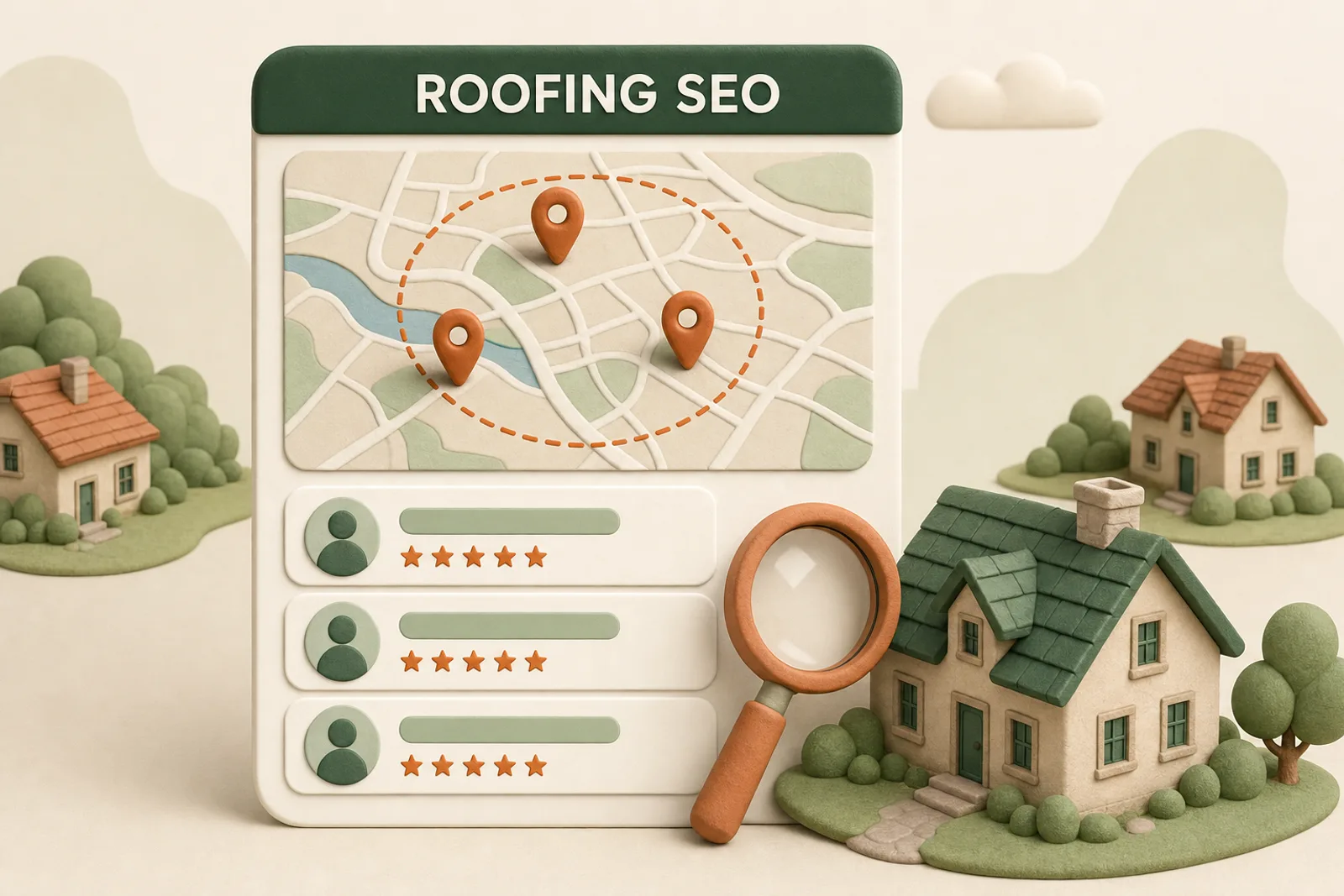
For local queries like “roofer near me” or “roof replacement [city],” you are really competing on two tracks at once: the map pack (the map with three business listings) and the organic results (the classic blue links). Different systems, overlapping inputs.
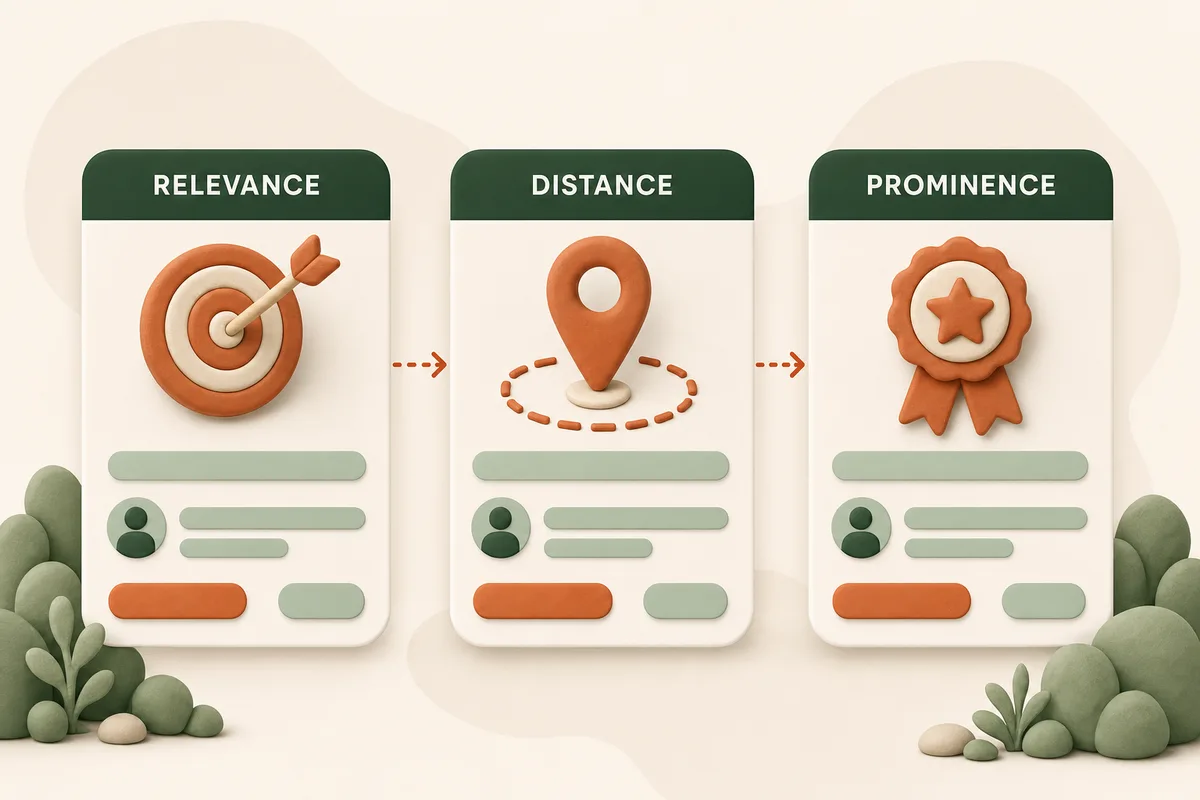
For the map pack, Google names its three ranking factors outright:
- Relevance: “how well a Business Profile matches what someone is searching for.” This is why your profile categories, services, and description matter.
- Distance: “how far each business is from the customer who’s searching.” You cannot change physics, but you can define your service area honestly and build presence in the towns you want.
- Prominence: “how well-known a business is,” which Google says is “based on info like how many websites link to your business and how many reviews you have. More reviews and positive ratings can help your business’s local ranking.”
And one sentence from that same page worth framing on the office wall: “There’s no way to request or pay for a better local ranking on Google.” Anyone selling you a shortcut to the map pack is selling around that sentence.
The foundation: your Google Business Profile
The highest-leverage half hour in roofing marketing is completing your Business Profile correctly, by Google’s own guidelines. The rules that trip up roofers specifically:
- Use your real name. “Your name should reflect your business’s real-world name,” not “Best Dallas Roofer | Free Estimates.” Keyword-stuffed names get profiles suspended.
- Service-area businesses have their own rules. Most roofers qualify: “businesses that serve customers at their locations should have one profile for the central office or location with a designated service area.” If customers do not visit your shop, hide the address and set the service area.
- No virtual offices. A rented mailing address you do not staff “isn’t eligible for a Business Profile.” The fake-office-in-every-suburb play gets profiles removed.
- Categories: fewer, truer. “Use as few categories as possible to describe your overall core business.” Roofing contractor first, then only what you genuinely do.
Then keep it accurate everywhere. SOCi’s survey found 63% of consumers have encountered inaccurate business listings, and 47% would switch to a competitor over it. Wrong hours or a dead phone number on a directory you forgot exists is quietly costing you calls.
Reviews: the numbers that should change your habits
If prominence is half profile and half reputation, reviews are the reputation half, and the 2026 numbers are blunt. BrightLocal’s Local Consumer Review Survey (February 2026, 1,002 US consumers):
- 97% of consumers read reviews for local businesses.
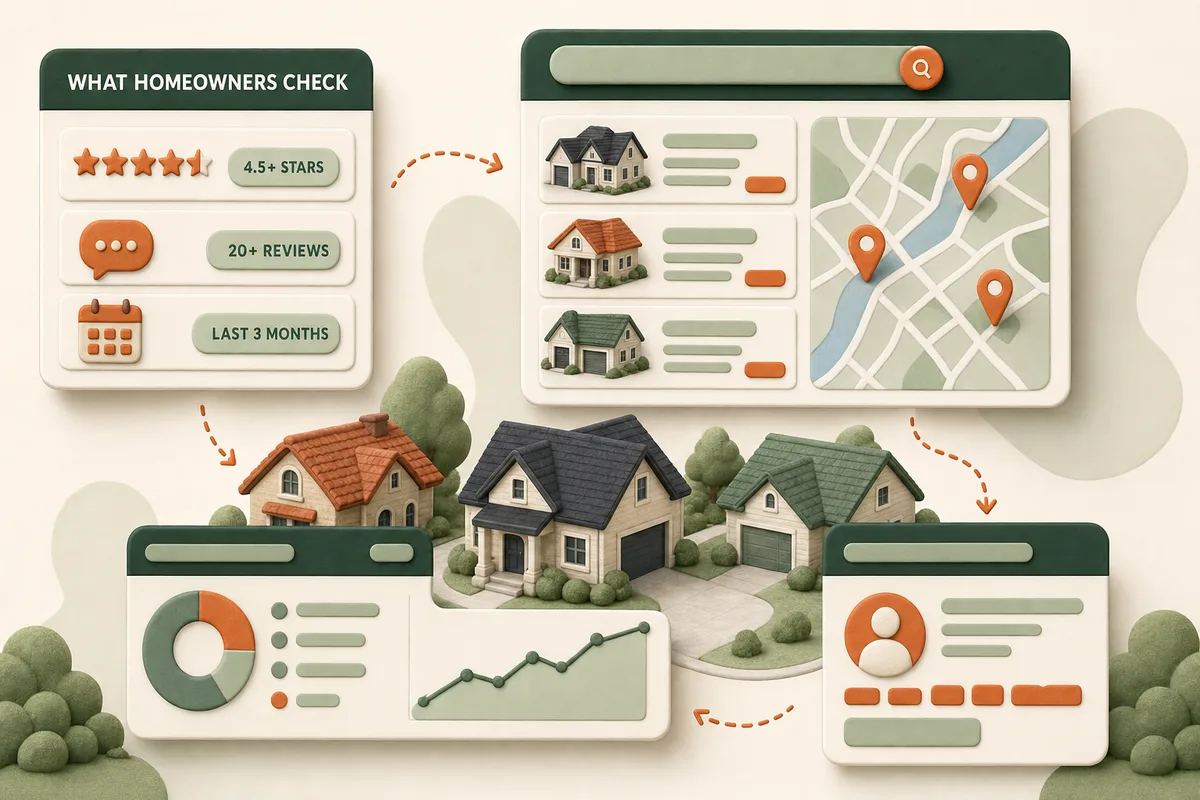
- 31% will only use a business rated 4.5 stars or higher.
- 47% will not use a business with fewer than 20 reviews.
- 74% only care about reviews written in the last three months.
- An owner response to reviews is a top-five trust factor, cited by 37%.
- 93% have made a purchase after reading reviews, and 27% have spent over $1,000 doing so.
Read those as thresholds, because that is how homeowners use them. Under 4.5 stars, under 20 reviews, or nothing recent, and a slice of the market filters you out before you ever get to bid. The operational fix is a habit, not a campaign: every completed job gets a review ask with a direct link, and every review gets a response. A steady trickle beats a blitz, especially with 74% of readers discounting anything older than three months.
One more 2026 shift from the same survey: Google’s share as a review destination dropped from 83% to 71% in a year while consumers spread across an average of six review platforms. Google first, but do not let the others rot.
Your website: built on keywords, judged in seconds
The map pack gets the glory, but the organic track and every “which of these three should I call” decision runs through your website.
Structure follows keywords. Our keyword data shows where demand actually sits: “roof replacement” pulls 90,000 US searches a month, “roof repair” 89,000, “roof repair near me” 67,000, “roofer near me” 31,000. Repair and replacement are different intents with different economics, and they need separate pages, as does each core service and each major city you serve. The full method is in how to choose keywords for your roofing company.
Conversion is not optional. A homeowner who lands and cannot find your number, your service area, or proof of real work leaves. Fast loads, click-to-call everywhere, real photos, visible reviews. What that build should cost, and the four ways to buy one, is covered in how much does a roofing website cost.
On devices, an honest note. You will read everywhere that “most local searches are mobile.” The verifiable current data is narrower: StatCounter’s US figures show desktop at 58% and mobile at 40% of overall web traffic. That measures all web traffic, not local searches, where urgency plausibly skews mobile. The practical conclusion survives either way: your site has to be excellent on a phone, because the leak-at-9pm homeowner is certainly holding one.
Content: answer what homeowners ask
After the service and city pages exist, content is how you cover the rest of the journey: cost questions, insurance questions, material comparisons, storm guidance. Every question you answer well is a page that can rank, a trust signal for the homeowner reading it, and raw material AI assistants can cite (more on that below).
The discipline that separates useful content from blog filler: each piece targets one real search, says something true and specific, and routes the reader toward the next step. That is the same standard we hold this blog to, sources and all.
Links and prominence, without the snake oil
Google’s prominence factor explicitly counts “how many websites link to your business.” For a local roofer that means a modest profile of genuinely local, relevant links: manufacturer certification directories, your state roofing association, the chamber, local press after storm events, sponsorships tagged correctly.
What it does not mean is buying ranking-credit links, which Google’s spam policy names directly and which mostly wastes money at local scale anyway. The full policy text, real market prices, and the local alternatives are in should roofing companies buy backlinks.
Technical SEO: the unglamorous 10%
Technical work will not rank a bad site, but it quietly caps a good one. The checklist that matters for roofers is short: the site loads fast on a phone, every page is crawlable and indexed, schema markup tells Google you are a roofing contractor serving specific areas, and tracking numbers and forms are wired so you know which pages produce calls. Set it up once, check it monthly, spend your creative energy elsewhere.
AI search is already here
The single most dramatic number in the 2026 research: consumers using ChatGPT and similar tools for local business recommendations jumped from 6% to 45% in one year (BrightLocal, February 2026), and 40% of consumers now use generative AI within search itself.
Before anyone sells you an “AI SEO” package: these tools recommend businesses based on the same public evidence Google weighs. A complete, accurate business profile. A review profile with volume, recency, and responses. A website that states plainly who you are, what you do, and where. Consistent information across the web. The roofers who win AI recommendations will be the ones who did local SEO properly, which is either reassuring or damning depending on how your fundamentals look today.
Storm and emergency work: SEO’s speed round
Roofing has a dynamic most industries do not: demand spikes overnight when weather hits. The SEO implication is that you build the pages before the storm. Emergency repair pages, storm damage guides, insurance claim explainers, all ranking calmly in the background, because the night a hailstorm hits your county is the wrong night to start writing. When ad prices spike storm-week as every roofer floods the auction, your organic rankings cost the same as they did in April: nothing marginal.
Timeline and cost, honestly
Timeline: movement in 30 to 60 days, meaningful lead flow in 3 to 6 months, compounding after that. Small markets run faster, metro markets slower. A month-to-month agency has to show progress inside that window to keep you; a 12-month contract exists to survive it.
Cost: industry surveys put average agency retainers around $3,200 a month, and the full sourced breakdown, from $99 productized plans to $10,000 enterprise retainers, is in how much does roofing SEO cost. What a sane total marketing budget looks like around it is in how much should a roofing company spend on marketing. And the questions that protect you from the wrong provider, in a zero-NPS industry, are in 10 questions to ask before hiring a roofing marketing agency.
Our own answer, for the record: one flat plan, $3,500 a month, everything included, one roofing company per service area, built for established companies doing $1M or more.
Where to start, in order
- Complete your Google Business Profile per the guidelines above. Free, today.
- Start the review habit: ask after every job, respond to everything. Free, forever.
- Fix listing accuracy everywhere your business appears.
- Get the website right: keyword-driven structure, fast, built to convert.
- Publish content that answers real homeowner questions, storm pages included.
- Earn local links from suppliers, associations, and press.
- Track calls and forms so every step above answers to one number: leads.
Or hand the whole stack to someone who does only this. If you want to know exactly where your company stands on every item on that list, get a free audit. I will review your profile, your rankings, your reviews, and your top three competitors, and give you the prioritized fix list whether you hire us or not.
Frequently asked questions
- What is roofing SEO?
- Roofing SEO is the work of making your company show up when homeowners in your service area search for roofing help: in the map pack, in the organic results, and increasingly in AI answers. It combines your Google Business Profile, your website's structure and content, your reviews, and the links and mentions that make Google confident you are a real, prominent local business.
- How long does roofing SEO take to work?
- Expect ranking movement in the first 30 to 60 days and meaningful lead flow in 3 to 6 months for most markets. Competitive metros take longer, small markets move faster. Anyone promising page one in 30 days is selling something other than SEO.
- Can I do roofing SEO myself?
- The foundations, yes: claiming and completing your Google Business Profile, building a review habit, and keeping your listing accurate are owner-doable and free. The compounding work (site structure, content, technical upkeep, tracking) is where owners run out of hours. Do the free foundations regardless of who you hire.
- How much does roofing SEO cost?
- Survey data puts average agency retainers around $3,200 a month, with real roofing SEO typically running $1,500 to $5,000 depending on scope and market. Our plan is a flat $3,500 a month with everything included. The full breakdown, with sources, is in our roofing SEO cost guide.
- Does AI search change roofing SEO?
- It raises the stakes on the same fundamentals. BrightLocal's 2026 survey found consumers using generative AI for local recommendations jumped from 6% to 45% in a year. AI tools lean on the same public signals: your business profile, your reviews, your website's clarity, and consistent information about who you are and where you work.
Read more

Why your roofing website isn't getting leads (a 15-minute diagnosis)
The seven failure points that silence a roofing website, in the order to check them, with the homeowner behavior data that explains each one.
What to expect from roofing SEO, month by month
The honest timeline nobody puts in the proposal: what actually happens in months 1 through 12 of a roofing SEO engagement, what to measure, and when to worry.