
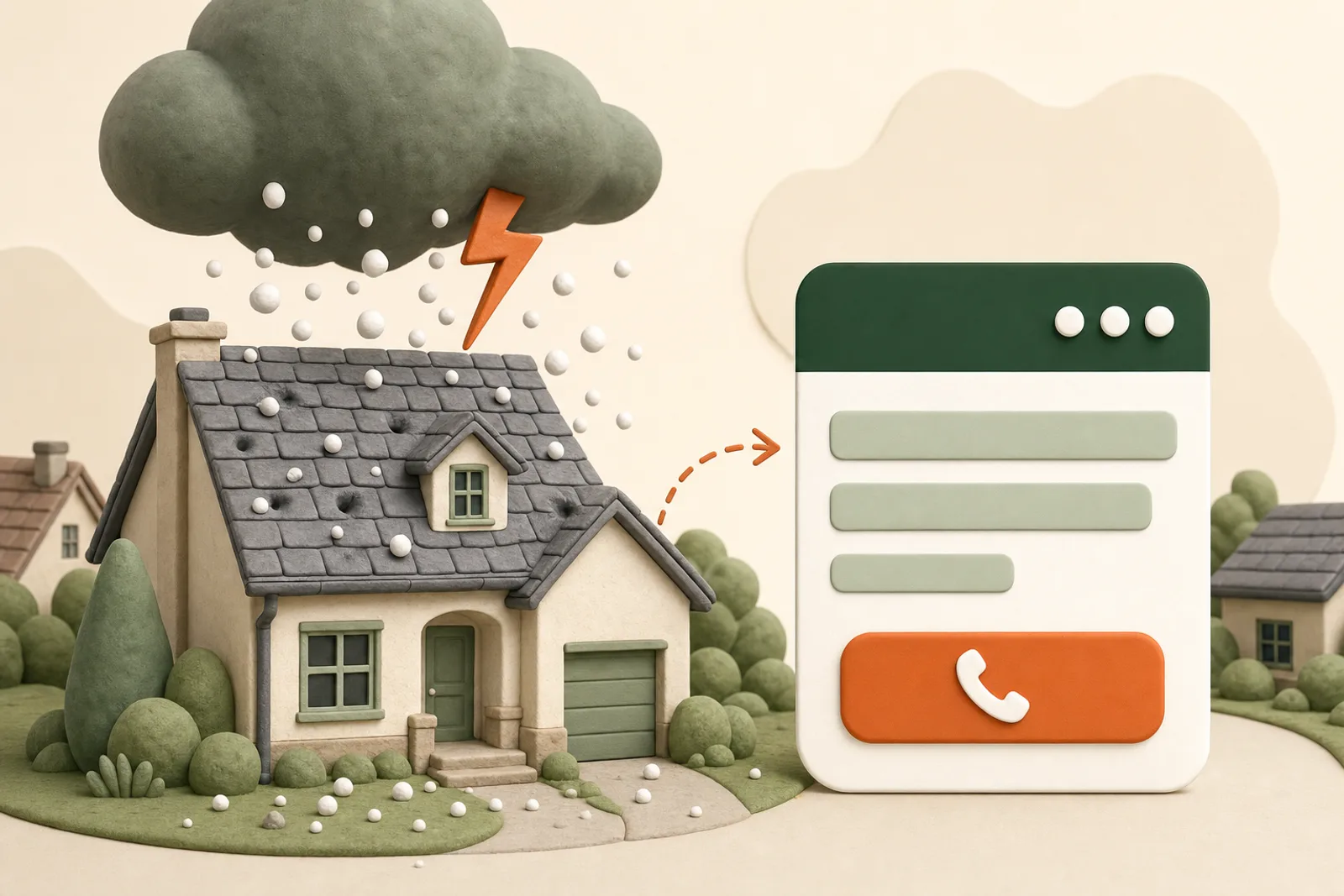

Storm work is the roofing industry’s paradox: the demand is enormous, predictable in aggregate, and completely unschedulable in the particular. You know hail is coming to your region this year. You have no idea which Tuesday.
That asymmetry is the entire marketing playbook: everything that wins storm week is built in the quiet months before it. Here is the system, with the storm and insurance data to size the opportunity.
The scale, in verified numbers
NOAA’s Storm Prediction Center logged 24,035 severe weather reports in 2024, including 1,796 confirmed tornadoes (second-most on record) and a new monthly record for significant hail: 470 reports of two-inch-plus hail in May 2024 alone, shattering the 2011 record of 316. The Insurance Information Institute’s hail page, citing SPC’s annual summaries, counts 5,432 US hail events in 2025, with Texas leading at 902.
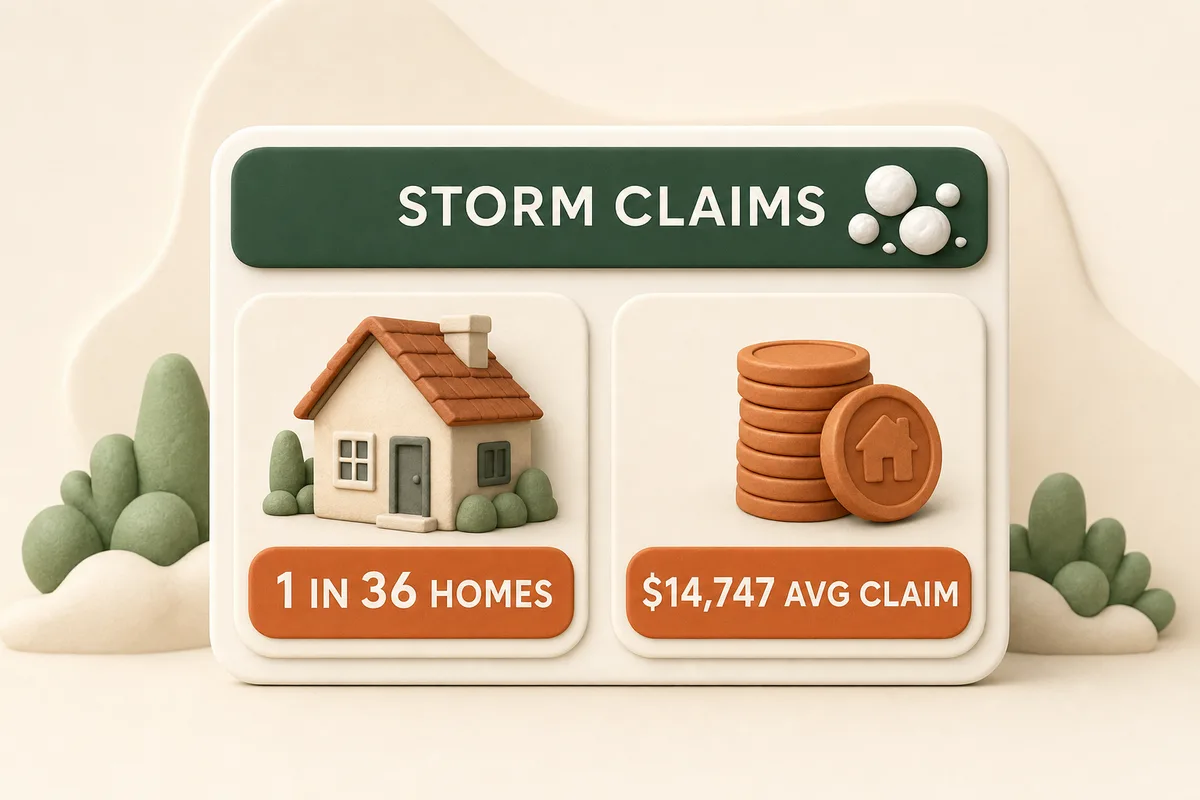
The insurance side is where the roofing revenue lives. III’s homeowners data (2019-2023): about 1 in 36 insured homes files a wind or hail property damage claim each year, the highest frequency of any claim cause, at an average severity of $14,747, with wind and hail driving 42.5% of all homeowners insurance losses in 2023. State Farm alone paid over $3.5 billion in hail claims in 2022.
One in thirty-six homes, every year, at nearly $15,000 a claim. That is the market that arrives with the front.
Phase 1: The pre-storm build (this is the whole game)
Search demand after a storm is instant; rankings are not. The pages must exist, be indexed, and be ranking before the radar lights up:
- An emergency repair page. “Emergency roof repair” pulls 14,000 US monthly searches at difficulty zero in our dataset, and the post-storm searcher is its most urgent form.
- A storm damage page. “Storm damage roof repair” (6,200 searches, difficulty 0) and “hail damage roof repair” (4,200, difficulty 0) are among the most winnable terms in roofing.
- An insurance claims guide. “How to get insurance to pay for roof replacement” carries 2,700 monthly searches at difficulty 5. Explain the process honestly: documentation, adjuster meetings, what insurers cover and what they do not, deductible law in your state. This single page does sales, SEO, and trust work simultaneously, and it feeds the repair-to-replacement pipeline.
- A hail/wind photo gallery of your actual storm work, updated after each event.
Build these in the off-season, interlink them, and let them quietly rank. The week the storm hits, your competitors start writing Facebook posts; your pages have been waiting on page one for months.
Phase 2: Storm week
When the event hits, the marketing job is presence and speed, not creation:
- Post on your Business Profile immediately. An update post (“Crews running storm inspections in [area] this week, call for a same-week slot”) shows every profile visitor you are active and local, per the cadence in our GBP guide.
- Be the calm expert for local press. Reporters need a licensed roofer who can say what homeowners should check and how claims work. That interview is trust and a local link in one.
- Ads, surgically if at all. Roofing already runs the highest cost per lead in home services ($228 per lead in LocaliQ’s benchmarks), and storm-week auctions get worse as chasers flood in. If your organic base is strong, spend the ad budget on the towns just outside your ranking radius, not on bidding against your own page-one listing.
- Answer the phone. Obvious, decisive, and the most commonly failed step of storm week. Overflow routing and a same-day callback promise outconvert any ad.
Phase 3: Beat the chasers by being the anti-chaser
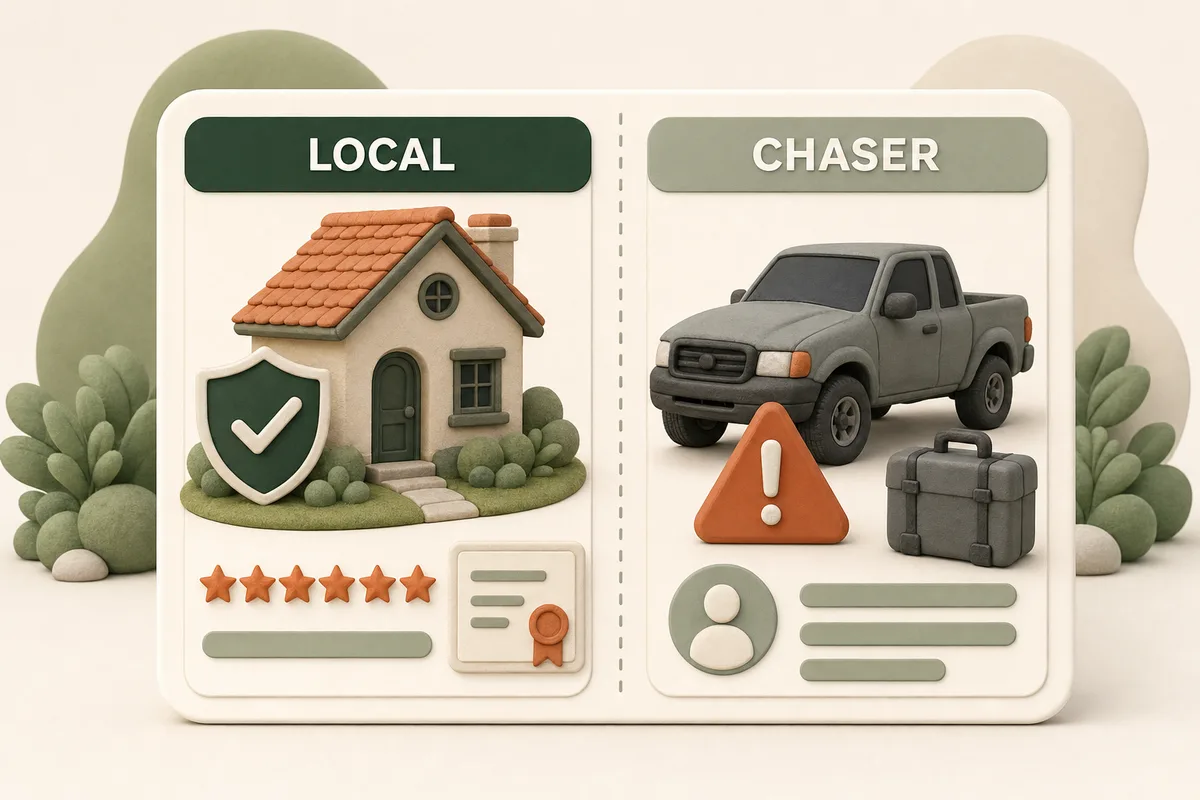
After every major event, out-of-market crews sweep in, knock doors, take deposits, and vanish on the warranty. Homeowners know the stories, which means fear is the dominant emotion in your market for the weeks after a storm, and the marketing opportunity is to be the visible opposite:
- Publish your physical address, license number, and insurance certificates on the storm pages.
- Add a plain-spoken “how to spot a storm chaser” section to the insurance guide: out-of-state plates, pressure to sign today, deposits before adjuster meetings, no local references. Homeowners share exactly this content with neighbors.
- Never inflate claims or promise “free roofs.” Beyond the ethics, insurance fraud content is a business-ending liability, and the honest version (“here is what your policy actually covers”) converts better with the homeowners you want.
The chaser has speed. You have a Google profile with 60 local reviews, a decade of local jobs, and a page that answered the homeowner’s insurance questions at 11pm before any door got knocked. The reviews engine and the storm pages are how that advantage becomes visible at the moment it matters.
Phase 4: After the wave
Two habits turn one storm into years of work. First, harvest the proof while it is fresh: photos, reviews from every completed storm job, and a short recap post per event (“What the June hailstorm did to roofs in [town]”), which builds the exact local-relevance record that ranks you for the next event. Second, run the numbers per channel: what did storm-week leads cost from organic, from ads, from referrals? The cost-per-booked-job math is never more revealing than in a demand spike.
Storm demand is coming to your market this year; NOAA’s numbers guarantee it in aggregate. Whether it lands on your phone or a chaser’s clipboard is decided months earlier. If you want to know whether your storm pages, profile, and rankings are ready before the season peaks, get a free audit and I will tell you exactly what is missing.
Frequently asked questions
- How big is storm damage as a share of roofing work?
- Large enough to organize a business around. Insurance Information Institute data shows about 1 in 36 insured homes files a wind or hail property damage claim each year, the highest claim frequency of any cause, with average severity of $14,747 and wind/hail accounting for 42.5% of homeowners insurance losses in 2023. State Farm alone paid over $3.5 billion in hail claims in 2022.
- When should a roofer start storm marketing?
- Months before the storm. The pages that win post-storm searches (emergency repair, storm damage, insurance claims) need to be built, indexed, and ranking before the event, because rankings take months and hail takes minutes. During the event you post updates and answer calls; you do not start writing.
- Should roofers run ads after a storm?
- Carefully, and with a calculator. Post-storm ad auctions spike as every roofer plus out-of-market chasers flood in, and roofing already carries the highest cost per lead in home services at $228 in benchmark data. The roofers who win storm weeks cheaply are the ones whose organic rankings and Business Profile were already in place, with ads as a surgical supplement.
- How do I compete with storm chasers after a hail event?
- By being verifiably local and verifiably honest. Publish your address, license, and insurance; show up in local search results the chasers cannot fake; explain the insurance claim process without inflating it; and warn homeowners about door-knocker red flags. Homeowners are nervous after storms, and the contractor who reduces fear wins the neighborhood for a decade.
Read more
Roofer marketing: the complete guide for 2026
Every roofing marketing channel with its real benchmark cost, the homeowner data that ranks them, a budget framework, and the order to build. All sourced.

Roofing marketing ideas that actually work (and the ones to skip)
Fifteen roofing marketing ideas ranked by evidence: what the homeowner data supports, what the cost data kills, and where to start with a real budget.