
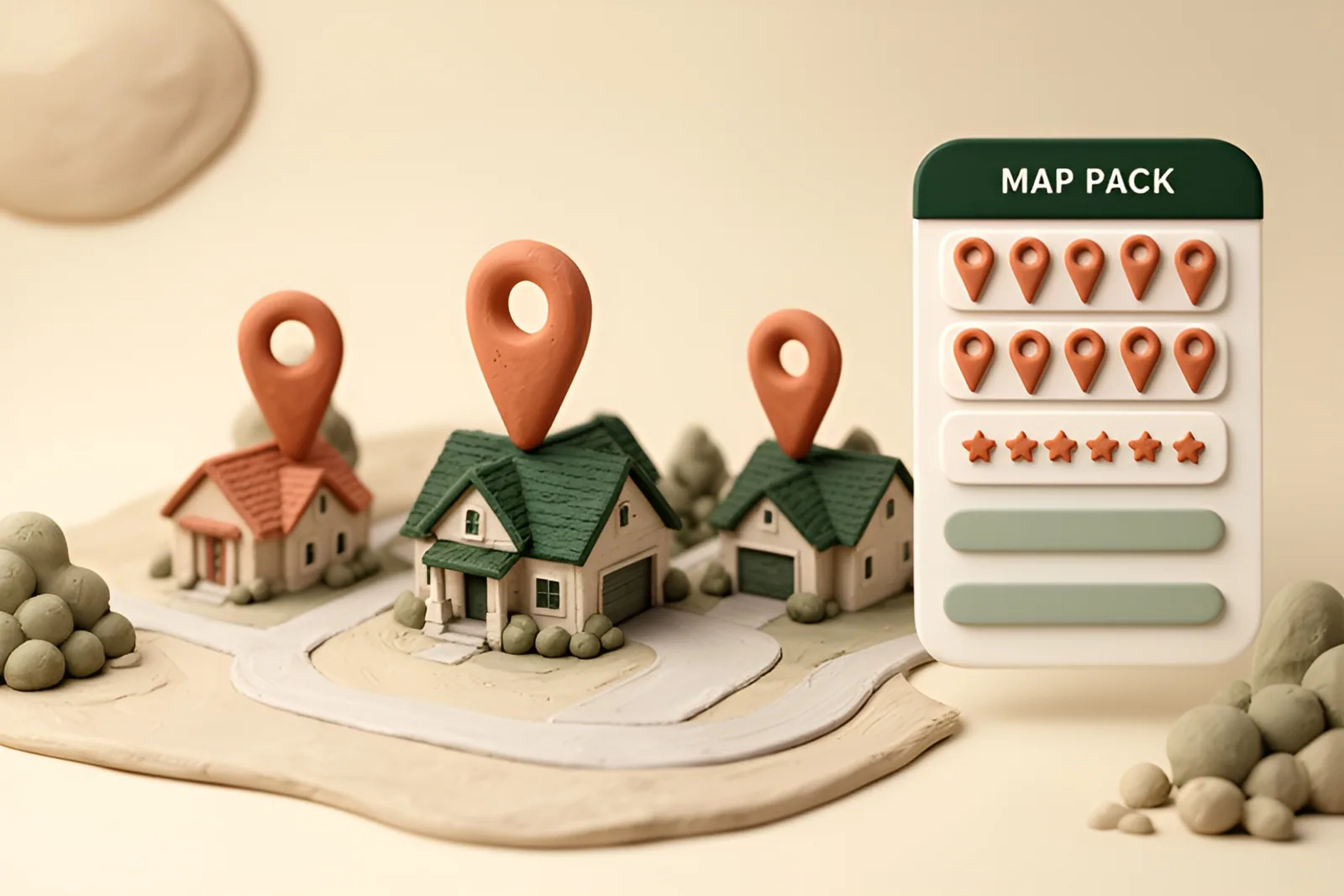

Local SEO for roofing companies comes down to one goal: be one of the three roofers Google shows in the map pack when a homeowner near you searches “roofer near me” or “roof repair in [your city]”. Those three listings sit above the regular results, carry your star rating and phone number, and take the calls.
The demand is real. In our free roofing keyword tool, “roof repair near me” alone gets 76,000 US searches a month, “roofer near me” 39,000, and “roofing company near me” 35,000. The 31 local-intent keywords in the tool add up to about 300,000 searches a month (Ahrefs Keywords Explorer, US, October 2026). Every one of those searches gets a map pack.
This post is the local SEO checklist I would hand a roofing company owner: what Google says it ranks on, what the best available expert data says moves the needle, what you can actually change, and what to skip. Every number links to its source.
How Google picks the three roofers in the map pack
Start with Google’s own words. Its help page, Tips to improve your local ranking, names three factors:
- Relevance: “how well a Business Profile matches what someone is searching for.”
- Distance: “how far each business is from the customer who’s searching.”
- Prominence: “how well-known a business is,” which Google says is also based on “how many websites link to your business and how many reviews you have.”
The same page says it plainly: “There’s no way to request or pay for a better local ranking on Google.” Ads can sit above the map pack, but nobody can buy a slot inside it.
Google does not publish weights for those three factors, so the best data we have is expert consensus. Whitespark’s 2026 Local Search Ranking Factors surveyed 47 local search experts, who scored 187 factors. Here are their top ten for the map pack, with what each one means for a roofer:
| Rank | Factor (Whitespark 2026) | What it means for a roofer |
|---|---|---|
| 1 | Primary GBP category | Set it to “Roofing contractor”. This is the single biggest lever you control. |
| 2 | Distance from searcher to business | You can’t move it. You can win more searches near your real base. |
| 3 | Keywords in the business name | Only counts if it is your real name. Never stuff it (more below). |
| 4 | Physical address in the city searched | Matters most for storefronts. Never fake it with a virtual office. |
| 5 | Open at the time of search | Accurate hours. List after-hours emergency service only if someone answers. |
| 6 | High Google star rating | A steady flow of real reviews from finished jobs. |
| 7 | Address showing (not a service-area business) | Most roofers are service-area businesses, and that is fine. |
| 8 | Additional categories | Add only true ones, like gutter or siding contractor if you do that work. |
| 9 | Number of Google reviews with text | Ask every customer, every job, the same way. |
| 10 | Correct map pin placement | Check the pin sits on your real building. |
Two notes on that table. First, the experts have no inside access to Google’s algorithm; Whitespark says so itself. Treat it as the best-informed opinion available, not a formula. Second, four of the top ten are about where you are and what you are, not anything you do every week. That is why the profile basics come first in the checklist below.
The map pack checklist, step by step
Here is the order I work in for local SEO for roofers. Each step makes the next one count for more.
Step 1: Get the Business Profile right before anything else
Your Google Business Profile is the map pack listing. Google’s guidelines for representing your business set the rules, and most roofers break at least one of them without knowing it:
- Primary category: “Roofing contractor”. Google asks you to “use as few categories as possible” and pick ones that complete the sentence “This business IS a.” Add secondary categories only for work you really do.
- Service-area setup: if homeowners don’t come to your office, you are a service-area business. Google’s rule: “If you’re a service-area business, you should hide your business address from customers.”
- Service area size: Google says your service area “shouldn’t extend farther than about 2 hours of driving time from where your business is based.” Listing every county in the state does not widen your reach. Distance still decides.
- No virtual offices: “P.O. boxes or mailboxes located at remote locations aren’t acceptable.” A rented mailing address in a city you want to rank in is not eligible for a profile. It is the fastest way to lose the one you have.
- Business name: your real name, exactly as on your truck and your license. Google: “Including unnecessary information in your business name isn’t permitted.”
- Hours: accurate. “Open at time of search” ranks fifth in the Whitespark survey, which is a real advantage for roofers who actually answer the phone at 9 p.m. during a storm, and a real liability for those who list 24/7 and don’t.
The GBP guide covers photos, posts, services, and the fields nobody fills. Do all of it once, properly, then keep it current.
Step 2: Build a review engine, not a review push
Reviews feed prominence, and they decide whether the homeowner calls you or the roofer next to you in the pack. BrightLocal’s Local Consumer Review Survey 2026 (1,002 US adults, published February 2026) gives you the thresholds homeowners actually apply:
- 97% of consumers read reviews for local businesses, and 41% always do (up from 29% in 2025).
- 47% won’t use a business with fewer than 20 reviews.
- 31% will only use a business rated 4.5 stars or higher (up from 17%).
- 74% look for reviews written in the last three months.
- 80% are likely to use a business that responds to all of its reviews.
That last-three-months number is the one that matters most for roofers. A company with 140 reviews and nothing new since spring looks worse than one with 60 and three from last week. The fix is a habit: every finished job gets the same short text with your review link, sent by the same person, the same day.
Stay on the right side of the rules. Google’s policy on fake engagement bans offering “incentives – such as payment, discounts, free goods and/or services” for reviews, and says businesses must not “selectively solicit positive reviews from customers.” The FTC’s final rule on fake reviews (announced August 2024) bans buying reviews and lets the agency seek civil penalties. Ask everyone, reward no one, and reply to every review. The full system is in how roofers win the map pack with reviews.
Step 3: Make your website prove the location
Google’s relevance factor reads your website as well as your profile, and your site is where the local organic results (the ten blue links below the map) come from. For a roofer that means:
- One strong page per core service: roof replacement, roof repair, storm damage, commercial roofing if you do it. Each answers what a homeowner in your area asks about that service.
- City pages that earn their place: a page for each town you really serve, with real jobs, real photos, and local detail (permit notes, the storm that hit last spring, the neighborhoods you work in). Google’s spam policies name “multiple domain names or pages targeted at specific regions or cities that funnel users to one page” as doorway abuse. Fifty pages that swap the city name are the textbook case.
- The same name, address, and phone number on every page, matching your profile exactly.
- Structured data: schema.org has a RoofingContractor type (a kind of LocalBusiness). Mark up your name, phone, service area, and hours with it.
- Your profile’s website link points to the page that best matches your main city, not always the home page.
If your site is slow, hard to use on a phone, or hides the phone number, rankings won’t save it. Why your roofing website isn’t getting leads covers the fixes; our roofing website design page shows how we build them.
Step 4: Clean listings and earn local links
Prominence also comes from the rest of the web. Two jobs here:
- Citations: your business listed with the same name, address, and phone on the directories that matter (Bing Places, Apple Business Connect, Yelp, the BBB, your manufacturer’s contractor locator, your chamber of commerce). The goal is consistency, not volume. Old addresses and old phone numbers from a move five years ago are what hurt.
- Local links: Google’s local ranking page counts “how many websites link to your business” toward prominence. The links that help roofers are the ones a real local business earns: supplier and manufacturer directories, trade associations, sponsorships, local news coverage of a project, the youth team you sponsor. Buying them is a different story; should roofers buy backlinks explains Google’s policy and the safer options.
Step 5: Track what the map pack actually sends you
Rankings are a means. Calls and booked jobs are the point. Set up:
- UTM tags on the profile’s website link, so profile visits show up separately in your analytics.
- Call tracking on the website, with the profile showing your main number (keep that number consistent everywhere).
- The Business Profile performance report, checked monthly for calls, direction requests, and website clicks.
- A grid rank check of your main keyword across your service area once a month. A single rank check from your office tells you almost nothing because distance changes the answer street by street.
Then tie it to jobs. If the map pack sent 40 calls last month, how many became inspections, and how many became signed roofs? That is the number that tells you whether local SEO is paying.
The checklist in one table
Print this or paste it into your project board.
| Task | Why it matters | How often |
|---|---|---|
| Primary category set to “Roofing contractor” | Top map pack factor in Whitespark 2026 | Once, then check yearly |
| Address hidden if you are a service-area business | Google’s own rule for SABs | Once |
| Service area within about 2 hours’ drive | Google’s guideline; distance decides anyway | Once |
| Real business name, no added keywords | Avoids suspension; Google bans extra info in names | Once |
| Accurate hours, emergency hours only if staffed | ”Open at time of search” ranks fifth | When hours change |
| Review request after every finished job | 74% of consumers check reviews from the last 3 months | Every job |
| Reply to every review | 80% favor businesses that respond to all reviews | Weekly |
| One page per service, real city pages | Relevance, and the local organic results | Build once, update quarterly |
| RoofingContractor schema on the site | Clear, machine-readable business details | Once |
| Same name, address, phone everywhere | Clean citations support prominence | Audit twice a year |
| Earn local links | Google counts links toward prominence | Ongoing |
| Track calls and booked jobs by source | Proves what local SEO is worth | Monthly |
Multiple locations, storm work, and other edge cases
More than one office. Google’s guidelines allow a service business with no storefront “one service-area Business Profile.” If you have separate locations with their own staff and service areas, you are “allowed one profile for each location.” A second profile at a warehouse where nobody works is not a location.
Storm season. After hail, search demand spikes and out-of-town crews show up with new profiles. Your edge is history: years of reviews, a real address in the area, and a profile Google already trusts. Keep posting job photos through the season. The storm and hail damage marketing playbook covers the rest.
Paid local results. Local Services Ads sit above the map pack and are a separate product with their own screening. The Business Profile is a prerequisite for them too. See Google Local Services Ads for roofers for costs and the 2026 changes. Regular search ads are covered in roofing PPC, and if you are weighing bought leads while rankings build, read buying roofing leads first.
Local SEO and AI search
Homeowners now ask AI tools for roofer recommendations too. In the same BrightLocal 2026 survey, the share of consumers using ChatGPT or other AI tools for local business recommendations rose from 6% to 45% in a year. Nobody can promise you a mention in those answers, and you should be wary of anyone who does. What the AI tools draw on looks a lot like what local SEO builds: a consistent business identity across the web, real reviews, and clear service pages. ChatGPT SEO for roofers covers what is known so far.
What local SEO can’t do
Honest limits, so you can plan around them:
- It can’t beat distance. A searcher standing next to a competitor’s shop will usually see that competitor. You win the area around your real base first, then widen it with reviews and links.
- It isn’t instant. Category and hours fixes can show up within weeks; review count and links take months. What to expect from roofing SEO, month by month lays out a realistic timeline.
- It can’t be bought. Google’s own words: there is no way to pay for a better local ranking.
Do it yourself or hire it out?
Steps 1, 2, and 5 are owner-doable in an afternoon plus a weekly habit. DIY roofing SEO walks through the free parts. Steps 3 and 4 (pages that rank, schema, citation cleanup, and earning links) are where most owners run out of time.
That second half is what our roofing SEO services cover, inside one flat monthly plan with the website, content, and lead tracking included. The price is published on our pricing page, with no contracts. For the bigger picture of how local fits with the rest of your rankings, read SEO for roofing contractors: the complete guide, and if your next question is how to choose what to rank for, the roofing SEO keywords guide uses the same Ahrefs data as this post.
If you want to know where you stand today, ask for a free audit. I will check your profile against this list, run a grid check of your main keyword, and show you the three roofers beating you in the map pack and why.
Frequently asked questions
- What is local SEO for roofing companies?
- Local SEO for roofing companies is the work that gets a roofer into Google's map pack (the three listings with a map) and the local organic results for searches like 'roofer near me' and 'roof repair in [city]'. It covers your Google Business Profile, reviews, city and service pages on your website, consistent listings across the web, and local links. Google ranks these results on relevance, distance, and prominence.
- How long does local SEO take for roofers?
- Profile fixes like the right primary category and accurate hours can move rankings within weeks. Review count and local links build over months. In most markets, plan on three to six months before map pack results are steady, longer in big metros with strong competitors. Anyone who promises a date for a specific ranking is guessing.
- Can a roofer rank in the map pack in a city where it has no office?
- Sometimes, but distance works against you. Distance from the searcher is one of Google's three local ranking factors, and Whitespark's 2026 expert survey ranks it second for the map pack. You can still rank in organic results for nearby cities with a strong city page. What you cannot do is rent a virtual office: Google's guidelines say a mailing address where you don't operate is not eligible for a Business Profile.
- Should I put keywords in my Google Business Profile name?
- Only if they are part of your real business name. Keywords in the business name rank third for map pack impact in Whitespark's 2026 survey, but Google's guidelines say unnecessary information in the name is not permitted. Adding 'Roof Repair Dallas' to a name that is legally 'Smith Exteriors' risks a suspension and gives competitors an easy edit to report.
- How many Google reviews does a roofer need?
- There is no fixed number for ranking, but there is one for homeowners: BrightLocal's 2026 survey found 47% of consumers won't use a business with fewer than 20 reviews, and 31% only use businesses rated 4.5 stars or higher. Recency matters too: 74% look for reviews written in the last three months. Aim for a steady flow from every finished job rather than a one-time push.
Read more

Why your roofing website isn't getting leads (a 15-minute diagnosis)
The seven failure points that silence a roofing website, in the order to check them, with the homeowner behavior data that explains each one.
What to expect from roofing SEO, month by month
The honest roofing SEO timeline: what happens in months 1 through 12 of an engagement, what to measure along the way, and when you should start to worry.