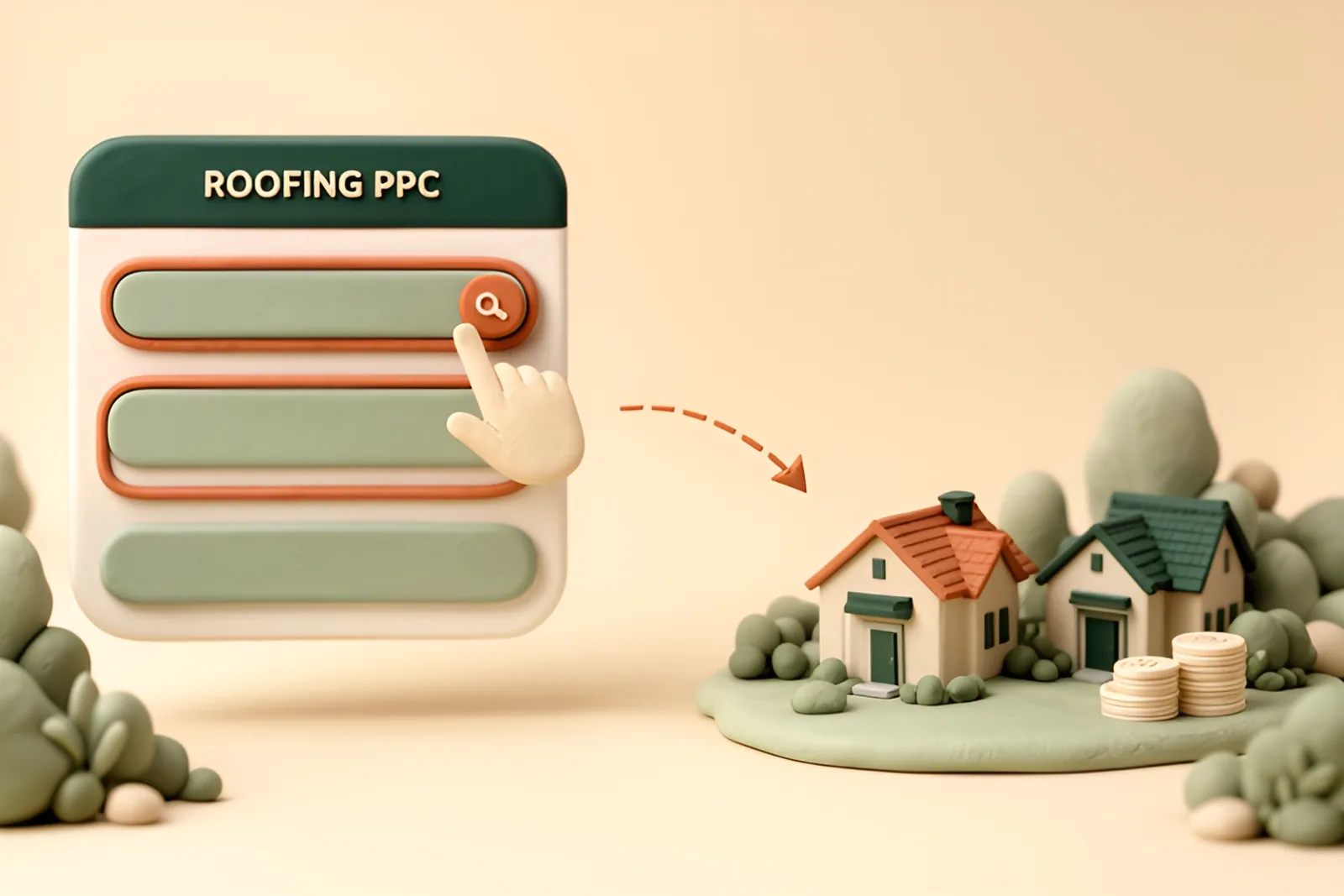

Roofing PPC means paying Google every time someone clicks your ad, usually a search ad above the organic results for “roof repair near me” or “roof replacement [city]”. It is the fastest way to get a roofing company’s phone ringing, and the most expensive click in home services.
Here are the numbers up front. LocaliQ’s home services benchmarks, built from 3,211 US search ad campaigns (April 2024 to March 2025 data), put roofing and gutters at $10.70 per click, a 3.70% conversion rate, and $228.15 per lead. That is the highest cost per lead of any home services category in the study. LocaliQ’s 2026 all-industry average is $66.69 per lead, so roofers pay about 3.4 times what the average business pays for the same thing.
That doesn’t make Google Ads for roofers a bad deal. It makes them a channel you have to run carefully and measure to the job. The rest of this post is how.
What Google Ads really cost roofers
The benchmark table, side by side. Note that the roofing and home services figures come from one LocaliQ dataset and the all-industry figures from its 2026 report, so the time periods differ slightly.
| Metric | Roofing and gutters | Home services average | All industries (2026) |
|---|---|---|---|
| Click-through rate | 5.66% | 6.37% | 6.64% |
| Cost per click | $10.70 | $7.85 | $5.42 |
| Conversion rate | 3.70% | 7.33% | 8.18% |
| Cost per lead | $228.15 | $90.92 | $66.69 |
Sources: LocaliQ home services benchmarks and search advertising benchmarks 2026.
The row that hurts is conversion rate. Roofing clicks cost more than the home services average and convert at about half its rate. Part of that is the buyer: a roof is a big, rare purchase, and many people click to compare before they call. Part of it is fixable: slow sites, weak landing pages, and ads that show for the wrong searches. Those fixes are most of this post.
A word on the CPC column in our roofing keyword tool. Ahrefs’ cost-per-click figures are estimates, and for roofing they often run low: “roof replacement near me” shows $0.90 there (Ahrefs Keywords Explorer, US, October 2026). Use the tool for search volume and for picking keywords. Plan your budget with measured campaign data like LocaliQ’s.
The budget math, worked through
Say you spend $3,000 a month on roofing Google Ads at benchmark rates:
- $3,000 at $10.70 a click buys about 280 clicks.
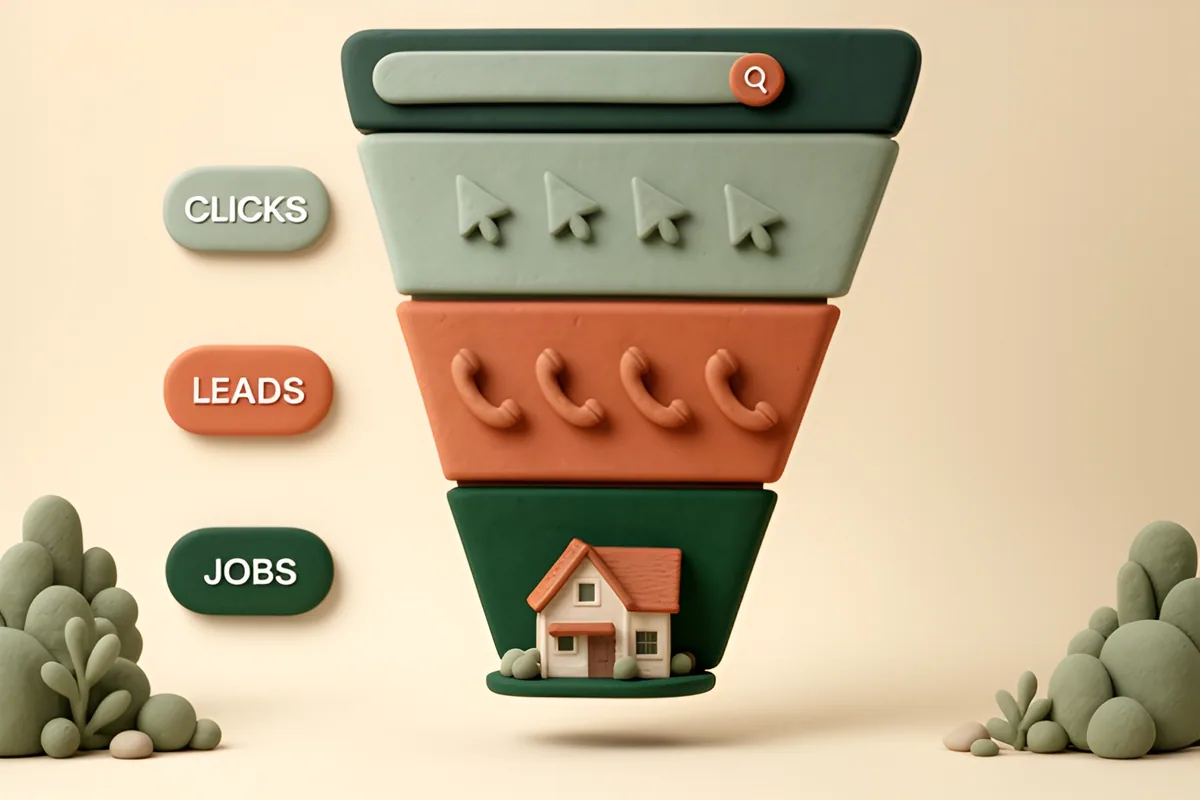
- At a 3.70% conversion rate, that is about 10 leads. At the benchmark $228.15 per lead, it is about 13. Plan for 10 to 13.
- Now apply your close rate. If you sign one in three of those leads (use your own number, not mine), that is 3 to 4 jobs, or roughly $750 to $1,000 in ad spend per job, before any management fee.
Compare that cost per job with your average gross profit on a job, not the ticket price. If the math works at benchmark rates, a well-run campaign that beats the benchmark is a good business. If it only works on paper at twice the benchmark conversion rate, don’t start.
Two budget mechanics to know before your first invoice. Google’s budget documentation says that “on a given day, your campaign might spend up to twice your average daily budget,” and that “at the end of the month, you will have spent no more than 30.4 times your average daily budget.” So a $100 daily budget can spend $200 on a stormy Tuesday, but caps out around $3,040 for the month.
How the auction sets your price
You don’t pay a list price for a click. You enter an auction every time someone searches. Google’s Ad Rank documentation lists what decides whether your ad shows and where: your bid, the quality of your ad and landing page (summarized as Quality Score), minimum thresholds, how competitive the auction is, the context of the search (location, device, time), and the expected impact of your ad assets.
The practical point for roofers: Google says higher-quality ads can lower what you pay per click. A relevant ad that leads to a fast page about the exact service searched for is cheaper to run than a generic ad that dumps everyone on your home page. Quality is the only part of the price you fully control.
How to set up roofing Google Ads that don’t waste money
This is the build order I use. Most wasted roofing PPC budget traces back to skipping one of these.
1. Search campaigns, organized by service
Separate campaigns or ad groups for each job type you want, each with its own ads and landing page. Volumes below are monthly US searches from our keyword tool (Ahrefs, US, October 2026), to show where the demand sits:
| Ad group | Example keywords | US searches a month |
|---|---|---|
| Roof replacement | roof replacement; roof replacement near me | 106,000; 27,000 |
| Roof repair | roof repair near me; roof repair | 76,000; 59,000 |
| Leaks and emergencies | roof leak repair; emergency roof repair near me | 24,000; 16,000 |
| Storm and hail | storm damage roof repair; hail damage roof repair | 14,000; 4,400 |
| Commercial | commercial roof repair; commercial roofing contractor | 12,000; 11,000 |
Those are national totals; your city’s share is a small slice of them. The point is the split: replacement and repair are separate jobs with separate margins, so they deserve separate budgets. The repair vs replacement keywords post explains why their economics differ.
2. Match types that fit your budget
Google’s match type guide explains the three options. Broad match (no symbols) is the default and can show your ad on related searches “even ones that don’t contain your exact words.” Phrase match (“roof repair”) and exact match ([roof repair]) give you more control and less reach. On a roofing budget of a few thousand dollars a month, I start with phrase and exact and earn my way into broad once conversion tracking is solid.
3. A negative keyword list from day one
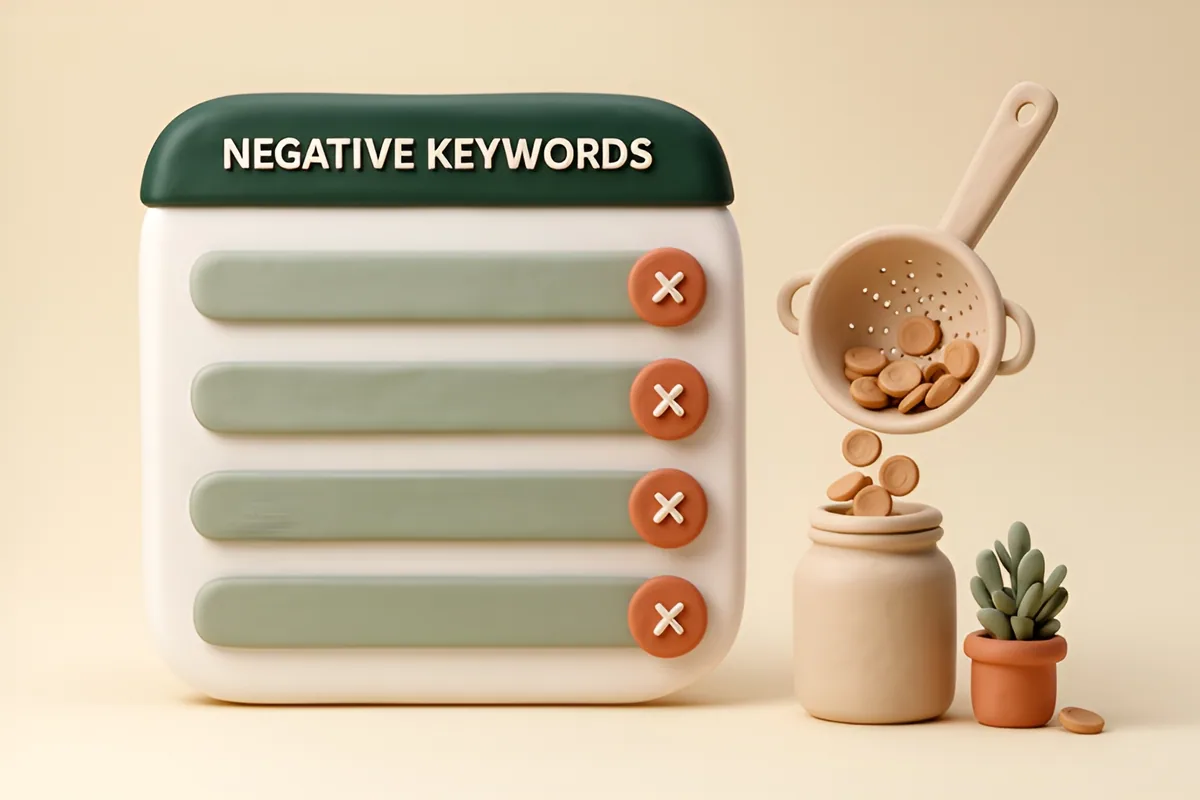
Negative keywords stop your ads from showing on searches you don’t want. Typical roofing negatives: jobs, hiring, salary, careers, training, school, license, DIY, “how to”, YouTube, supplies, and product searches for shingles and materials you don’t sell. One catch from Google’s negative keyword documentation: “Negative keywords won’t match to close variants or other expansions,” so add the plurals and synonyms yourself. Review the search terms report weekly for the first two months and keep adding.
4. Location targeting set to where people are
Google’s location options default to “Presence or interest,” which reaches people in your area plus people who have “shown interest” in it. For a roofer, a homeowner two states away reading about your city is not a lead. Switch to “Presence” (people in or regularly in your area) unless you have a reason not to, and set the radius to where your crews actually go.
5. Ad assets that put the phone first
Add call assets (your number on the ad), location assets (linked to your Google Business Profile), and sitelinks to your main service pages. Asset impact is one of the Ad Rank factors, and most roofing leads want to talk to someone.
6. Landing pages built for one job
Every ad group sends people to a page about that service, in that area, with the phone number at the top, a short form, real photos, your reviews, and your license and insurance details. Remember that 3.70% conversion rate: the page is where most roofing ad budgets leak. Why your roofing website isn’t getting leads is the checklist, and our roofing website design work is built around it.
7. Ad copy that a homeowner can check
Roofing ads all start to look alike: “Trusted Local Roofers, Free Estimates.” Write ads that a homeowner can verify:
- The service and the town in the headline, matching the ad group: “Roof Leak Repair in Plano” beats “Quality Roofing Solutions.”
- One proof point you can back up: years in business, your license number, a manufacturer certification you actually hold, or your Google review count.
- A next step that is true: “Free inspection” only if it is free with no strings. “Call now” only during hours when a person answers.
- Nothing about insurance you can’t stand behind. Storm ads that hint you will cover a deductible can break state law. Texas, for example, says it is “illegal in Texas for a contractor to offer to waive, rebate, or absorb a property policyholder’s deductible” (Texas Department of Insurance). Check your state’s rules before you write storm copy.
Also set an ad schedule so ads run only when someone can pick up the phone, or route after-hours calls to a person who can book an inspection. A lead that hits voicemail at 7 p.m. is often a lead for the next roofer on the page.
8. Conversion tracking to the job, not the click
Google’s call conversion documentation covers calls from your ads, calls from your website (to a number shown on the site or from a tap on it), and imported calls if another system knows which calls turned into sales. Set up all of the ones that apply, then go one step further: mark which leads became inspections and which became signed jobs. Without that last step, Google optimizes for whoever fills out the most forms, and so do you.
Invalid clicks are Google’s job, not yours. Its invalid traffic policy says you aren’t charged for clicks that “don’t represent a genuine interest in your business,” and that invalid clicks found after billing are credited “where appropriate and possible.”
Your first 30 days of roofing PPC
A launch plan that keeps the first month’s spend from turning into tuition:
- Week 1: tracking live and tested (place a test call from a phone), one landing page each for repair and replacement, two ad groups only, phrase and exact match, “Presence” targeting, the starter negative list, and an ad schedule.
- Week 2: read the search terms report every day or two and add negatives. Listen to call recordings or check the call log: are these homeowners, or job seekers and vendors?
- Week 3: move budget toward the ad group producing real leads. Add a third ad group (leaks or storm) only if the first two are clean.
- Week 4: first honest read of cost per lead against the $228 benchmark. Don’t judge cost per job yet. Roof replacements often take weeks to sign, so give it 60 to 90 days and judge on signed contracts.
If the account still sends mostly junk after a month of weekly cleanup, the problem is usually the targeting or the page, not the budget. Spending more just buys more of the same.
Google Ads vs Local Services Ads vs Performance Max
Three Google products compete for the same homeowner:
- Search ads (this post): pay per click, you control keywords, ads, and landing pages.
- Local Services Ads: pay per lead, Google screening and the Google Verified badge, shown above search ads. Costs and rules are in Google Local Services Ads for roofers.
- Performance Max: Google’s automated campaign type that runs across search, maps, YouTube, and more from one budget.
The big change this year: Google’s migration notice says Local Services Ads are moving into a Performance Max campaign type with pay-per-lead goals, with “the first phase of the migration” starting in August 2026 “for select home and storefront service advertisers in the United States.” You still “only pay for valid leads,” but “manual bidding (such as setting a maximum cost-per-lead) is no longer supported.” If you run both LSAs and search ads, expect your account structure to change in the next year.
Who should run your roofing PPC
Doing it yourself works if you will spend a couple of hours a week in the account: search terms, negatives, bids, and the call log. It does not work as a set-and-forget task.
Hiring someone adds a fee on top of the ad spend. OuterBox’s 2026 PPC pricing guide puts percentage-of-spend fees “around 10% to 20% of monthly media spend,” and flat fees of $500 to $2,000 a month for accounts spending $1,000 to $5,000. It calls these “planning ranges, not quotes,” and it is an agency’s own guide, so treat it as a rough market range. Whoever you hire, ask for read access to the account in your name, a weekly search terms review, and reporting by booked job. The 10 questions to ask a roofing marketing agency apply here too.
When roofing PPC is worth it, and when to stop
PPC earns its place when speed matters more than cost:
- Storm season, when demand spikes for a few weeks and organic rankings can’t move that fast. See the storm and hail damage marketing playbook.
- A new service area where you have no reviews or rankings yet.
- Slow months when an empty crew costs more than the leads.
- Testing which services and towns produce profitable jobs before you invest in pages and rankings there.
It is a poor permanent foundation, because the meter never stops: the day you pause, the leads stop. Roofing SEO vs Google Ads compares the two over five years, and what roofing leads actually cost converts every channel into cost per booked job. For the overall split, read how much a roofing company should spend on marketing. If you are weighing PPC against lead sellers, buying roofing leads covers what those companies sell, and the local SEO checklist for roofing companies covers the map pack listings that sit right below your ads.
The plan most established roofers end up with: PPC and LSAs as the tap you open and close, SEO as the asset that keeps producing. Our roofing lead generation and SEO work is built on that second part, in one flat plan with no contracts, and the price is on our pricing page. If you already run Google Ads and want a second opinion, ask for a free audit: I will look at your search terms, your tracking, and your cost per job, and tell you what I would cut.
Frequently asked questions
- How much does Google Ads cost for roofers?
- In LocaliQ's benchmark data (3,211 US search campaigns, April 2024 to March 2025), roofing and gutters averaged $10.70 per click and $228.15 per lead, the highest cost per lead of any home services category. What you pay depends on your market, your bids, and your ad and landing page quality. Most roofers who run Google Ads seriously spend a few thousand dollars a month on clicks, plus any management fee.
- Is PPC worth it for roofing companies?
- It can be, when you track it to booked jobs. Search ads put you in front of homeowners who are ready to hire, and you can switch them on in days. They are expensive in roofing and stop working the day you stop paying, so they work best for storm season, a new service area, or filling a slow month while SEO builds.
- How much should a roofer spend on Google Ads?
- Work backward from jobs. At the benchmark $228 per lead, $3,000 a month buys about 13 leads. Multiply by your own close rate to see the jobs, then compare the cost per job to your average job profit. If you can't afford enough budget to get at least 10 to 15 leads a month, the data will be too thin to tell you whether it works.
- What is the difference between Google Ads and Local Services Ads for roofers?
- Google Ads search campaigns charge per click and send people to your website. Local Services Ads charge per lead (a call or message), require Google's screening, and show a Google Verified badge above the regular ads. Starting August 2026, Google is moving LSA accounts into Performance Max campaigns with pay-per-lead goals.
- What keywords should roofers bid on in Google Ads?
- Hiring searches with a service and a place: roof replacement, roof repair, roof leak repair, emergency roof repair, storm and hail damage repair, plus 'near me' and city versions. Skip research and DIY searches, job seekers, and supply searches with a negative keyword list. Our free roofing keyword tool shows US volumes for 245 customer-side roofing searches.
Read more
Roofer marketing: the complete guide to roofing contractor marketing (2026)
Roofing contractor marketing, ranked: every channel with its real benchmark cost, the homeowner data behind it, a budget framework, and the order to build.

Roofing marketing ideas that actually work (and the ones to skip)
Fifteen roofing marketing ideas ranked by evidence: what the homeowner data supports, what the cost data kills, and where to start with a real budget.